Oral Sphere
Journal of Dental and Health Sciences

Journal of Dental and Health Sciences
Received: 2025-03-01
Accepted: 2025-05-25
Published: 2025-07-01
Pages: 149-155
Introduction: Vestibular function plays a crucial role in maintaining normal balance throughout day-to-day life. The neck muscles also play a role in maintaining the body's equilibrium. The study aims to assess the effect of vestibular rehabilitation on balance among the individuals with neck pain and to improve it through vestibular adaptive exercises. Through this study, individuals will be more aware and focused on balancing problems associated with neck pain while performing activities of daily living.
Methodology: In total, 50 individuals who have neck pain will be participating in this study. Dynamic balance ability is evaluated by the time up and go (TUG) test and the star excursion balance test (SEBT). Static balance ability is tested using a one-leg stance test (OLST) and Romberg test. Baseline and one week post vestibular intervention will be collected.
Result: The result shows that after conducting pre-test and post-test, there is an improvement among the individuals. The mean value for participants’ age is 20.8, and BMI =23.5. The SEBT (all directions) is significant at p-value≤ 0.05.
Conclusion: By Vestibular Rehabilitation, Balance with neck pain and Vestibular function could be treated among individuals with neck pain.
People with vestibular disorders often experience balance or movement-related problems in their bodies. The primary symptoms are usually accompanied by secondary symptoms associated with reduced activity levels in their day-to-day life [1]. Secondary symptoms include decreased strength, loss of range of motion and increased tension mainly in the neck region, leading to muscle fatigue and headaches. There is a high chance of stagnation of the cervical spine's proprioceptive capacities, which can hinder our neck movement.1 These symptoms affect a person’s ability to change positions (such as lying down) or move about without imbalance and vertigo. Activity of daily living depends on how well a person can accomplish their tasks by balancing and coordinating their body [2].
Neck axial muscles have proprioception during both variable and invariant positions. Neck movement, combined with trunk proprioception and vestibular sense, has reached a highly developed level. The neck muscles create the vibration that relates to body position and head deviations. Even a sedentary lifestyle may be debilitating enough to diminish quality of life, reduce employability and complicate all aspects of life. The result can be economic and social devastation [3]. The neck muscles play a crucial role in Postural control, providing direct access to the vestibular nuclear complex and the reflex Centre for coordination between vision and neck movement. Postural stability results from the complex coordination of central processing from visual, vestibular and somatosensory pathways and resultant efferent response. Dynamic postural stability assessment of an individual’s ability to maintain balance while transitioning from a dynamic to a static position. Dynamic balance can affect our goal-achieving techniques of daily living [4].
The inner ear plays a crucial role in maintaining balance and spatial orientation. Head deviation while prolonged acceleration can disturb the Endolymph in the canal ensures our postural balance. This may lead to Vestibular Dysfunction and can affect the Activities of Daily Living in asymptomatic patients [5]. In previous studies, it is evident that activation and endurance of the deep cervical flexor muscles can be facilitated by a craniocervical flexion and proprioception training programme [6].
It has also been shown that symptoms of cervicogenic dizziness can be reduced by combining manual therapy with vestibular rehabilitation, thereby improving the patient’s condition. Researchers have also conducted a study on individuals facing problems such as dizziness and imbalance, which can be related to impairments in eye-head coordination, static balance, and ambulation [7].
There has been a study conducted in a 64-year-old woman who had a sudden neck swelling and rash likely due to late SARS-CoV2. The Neck swelling resolved in less than 24 h. Sudden neck swelling with a rash is a possible direct and indirect sign of COVID19 when all the other differential diagnoses have been ruled out in a pandemic context [8].
We conducted this study because the neck muscles can hinder head movement and its orientation. Neck pain is common nowadays, and it can be caused by a poor lifestyle or a medical condition, affecting the neck muscles and the dysfunction of the vestibular system. Vestibular rehabilitation is a specialised form of therapy designed to eliminate this problem. The purpose is to investigate the correlation between mechanical neck pain and dynamic balance in asymptomatic individuals in their daily lives. The study included the Neck Disability Index, self-rated disability due to neck pain, and the Star Excursion Balance Test for dynamic balance. In this neck pain case, self-reported pain and disability are usually the primary questions for this study.
Study Design: The data were recruited and screened according to baseline criteria at the Maharishi Markandeshwar Institute of Physiotherapy and Rehabilitation, Mullana. The study was performed as an observational cross-sectional study. The study was conducted from September 2017 to October 2017. Before participating in the survey, Informed consent was collected from all participants.
Participants: The selection criteria are purely based on inclusion and exclusion criteria. The inclusion area of study includes Individuals aged 18-30 years. The test was conducted between the female and the male. The focus is on mechanical neck pain having balance impairment. We collected Demographic Data, which includes Age, sex, height and weight. We then performed the Star Excursion Balance test.
Procedure: The outcome measurements include the Neck Disability Index (NDI) and the Star Excursion Balance Test (SEBT). After the selection of the criteria, we need to go for the Neck disability Index and the Star Excursion Balance Test.
Ten questions were asked, and ratings were given on a scale of 0- 5. The question has been revised to include additional items – headache, reading, concentration, and work - resulting in a 10-item scale. The rating scale, ranging from 0 to 5, determines whether the individual is a good fit or not.
The Star excursion balance test has been conducted for the dynamic postural stability. The Star excursion balance test is a dynamic test that requires strength, flexibility, and proprioception, assessing physical performance, and can also be used to screen deficits in dynamic postural control. There is a line drawn in 8 different directions, each line being 120 cm long, at a 45-degree angle.
The person needs to maintain one foot at the centre, and the other foot should touch all eight different direction lines. This will determine the person's dynamic balance and whether they are suitable for the study or not. After all the assessments, all individuals were going to receive the vestibular rehabilitation for 2 weeks, 5 days per week.
Intervention: The protocol has been developed in accordance with the participant’s consent. So that participants can perform these exercises easily and won’t face any sort of difficulties. They can also perform by themselves at home. To follow these vestibular exercises requires at least 30 minutes, with 5-7 minutes allocated for each exercise, and rest is dependent on individual capacity.
The exercises are also set according to the outcome measures, which focus on achieving dynamic balance, and should be completed more accurately during SEBT than in the previous attempt.
Outcome Variables: The study has variables; independent variables include vestibular rehabilitation and balance exercises. On the other hand, the dependent variables are neck pain and balance. This study has assessed the person's dynamic balance and determined whether it is relevant to the research. After all the assessments, all individuals have received the vestibular rehabilitation for 2 weeks, 5 days per week.
Sample Size: There are a total of 29 participants for the study. The selection criteria are purely based on inclusion and exclusion criteria. The area of study includes Individuals between 18 and 30 years old. The test was conducted between the female and the male. The focus is on mechanical neck pain having balance impairment.
Ethical statement: The study is based solely on asymptomatic individuals, including both males and females. The protocol for each exercise has been planned to accommodate beginners according to their convenience. These exercises are demonstrated under observation. The entire procedure, as well as the interventions, are discussed with the individuals before they are included in this study. The main aim is to help them with their balance while managing their regular task.
Statistical Analysis: All the Data collected were subjected to a non-parametric Distribution, the Wilcoxon Signed Rank Test. All the Data were examined for normal distribution. The Star Excursion Balance Test was used to rule out vestibular dysfunction in both the pre-test and post-test, which were recorded. Statistical analyses were conducted by using SPSS version 16.0. The results were considered significant at the p ≤ 0.05 level to assist in the data analysis.
The study has a total of 29 participants who met all the inclusion criteria. The result was considered significant at a p ≤ 0.05 level. All data were examined for normal distribution using the Wilcoxon signed rank test for non-parametric distribution.
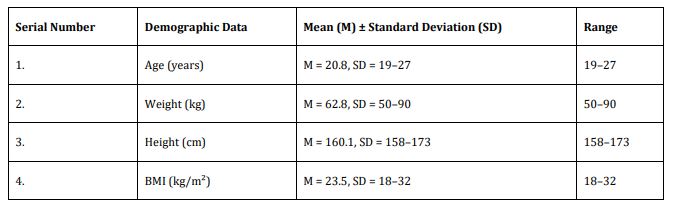
In Balance Exercise for a patient with Neck pain Table 1, all the interventions given to the patients have been repeated with the specified sets. The baseline and demographic characteristics Table 2 of all participants were collected in accordance with the selection criteria.
The Wilcoxon test shows that the score of the SEBT Star Excursion Balance Test (in all eight directions) is significant at p ≤ 0.05 Table 3, with pre- and post-test (in cm).
| Serial Number | Position | Exercise Technique | Repetitions |
|---|---|---|---|
| 1 | In bed or sitting | Eye ball movement, up and down or side to side. Head movement, bending forward and backwards. Turning from side to side. | 3 repetitions, 2 sets – 5 days/week each |
| 2 | Sitting | Eye and head movements together, shrug and circle shoulders. Bend forward and try to pick up any objects from the ground, and again coming back. This can also be done through side-to-side bending. | 3 repetitions, 2 sets – 5 days/week |
| 3 | Standing | Eye, head and shoulder movements are done one by one. Changing position from sitting to standing with eyes open and closed, turning around in between. Throw a ball from hand-to-hand above eye level. | 3 repetitions, 2 sets – 5 days/week |
| 4 | Cawthorne-Cooksey exercise | Relaxing the neck and shoulder muscles. Patient needs to move his/her head under a supervisor for motivation, either a therapist or family members. | 2 repetitions, 1 set – 5 days/week |
| 5 | Moving about | Walks up and down a slope. Walks up and down the steps. Throw and catch a ball. | Once a day |
| 6 | Gaze stabilisation exercises | Focus on a letter (e.g. A) at the level of the eye. Then bend the head side to side. If it gets too dizzy, it needs to slow down. | Once a day |
| 7 | Ambulation exercise | Patient tries to march step down and up in one place, moving without walking. | 4 repetitions, 2 sets – 5 days/week |
| 8 | Side lounge | Standing tall with feet parallel, the back should be straight, and weight should be on heels. Take a big step aside. Keep your torso upright and lower your knee, bent around 90°. Keeping your trailing leg straight. | 3 repetitions, 2 sets – 5 days/week |
| Serial Number | Demographic Data | Mean (M) ± Standard Deviation (SD) | Range |
|---|---|---|---|
| 1 | Age (years) | M = 20.8, SD = 19–27 | 19–27 |
| 2 | Weight (kg) | M = 62.8, SD = 50–90 | 50–90 |
| 3 | Height (cm) | M = 160.1, SD = 158–173 | 158–173 |
| 4 | BMI (kg/m²) | M = 23.5, SD = 18–32 | 18–32 |
| Serial Number | Demographic Data | Mean (M) ± Standard Deviation (SD) | Range |
|---|---|---|---|
| 1 | Age (years) | M = 20.8, SD = 19–27 | 19–27 |
| 2 | Weight (kg) | M = 62.8, SD = 50–90 | 50–90 |
| 3 | Height (cm) | M = 160.1, SD = 158–173 | 158–173 |
| 4 | BMI (kg/m²) | M = 23.5, SD = 18–32 | 18–32 |
In this study, we observed a relatively high progression rate among individuals undergoing vestibular rehabilitation. Earlier, the major complaint among individuals was that during their regular activity, they sometimes couldn’t balance themselves properly, and with neck pain, it made it more difficult. The individuals also stated that neck pain was an aggravating factor for misbalancing themselves many times. They couldn’t focus on their ongoing work at that particular time. The neck pain creates a feeling of disorientation and unsteadiness. Some patients experienced mild headaches and neck pain while performing the Star Excursion Balance Test, which led to Poor Balance. This also includes another fact: a Headache is often accompanied by Neck Pain, which hinders the range of motion in the neck. The protocol for this exercise Table No. 1 is designed to provide relief from neck pain and improve balance. Effective results have been shown by following these exercises. A study by Peng et al. [9] states that impaired proprioception and postural control associated with neck pain can be addressed through a treatment protocol; however, the effect on neuromuscular function in people is not known. By doing this, we have included only those individuals who experienced neck pain to investigate any relationship between balance and neck twinge. The muscles of the neck have receptors that send signals controlling head movement and orientation. The head movement makes control of the vestibular apparatus or the inner ear, which is responsible for maintaining our posture as well as balance. After conducting the Neck Disability Index and the Star Excursion Balance test, we have concluded that individuals with neck pain may experience balance disturbances. The individuals who participated in the study were not very active in physical activities such as brisk walking, jogging, and yoga. The protocol is included to reveal impairments in dynamic coordination, eye-head movement, and ambulation. The tight neck muscles can cause dizziness. or a headache. The reason for tightness in neck muscles can be due to carrying a poor posture several times. A body built up may be skinny or obese, or have weak abdominal muscles, which can disrupt the spine’s normal structure, often causing the neck to move forward to compensate. This compensating mechanism can lead to poor alignment of the neck muscles. The participants have followed all the exercises daily as mentioned above. The active participation of the individuals has reduced the symptoms of imbalance. The study's results showed clinical improvement in all participants. The result of the data analysis rejects the null hypothesis and accepts the alternative hypothesis, indicating a greater clinical effect of vestibular rehabilitation with balance exercises on balance among individuals with asymptomatic vestibular dysfunction and neck pain.
In this study, the improvement of balance is significant both clinically and statistically. For non-parametric distribution, the Wilcoxon Signed Rank test shows the significance of all the directions of the Star Excursion Balance Test ( value <0.01). The Star Excursion Balance Test involves following eight different lines, each 120 cm in length, marked at 45- degree angles in all eight directions. The medial and lateral scores are excluded during data analysis because there is no difference between pre- and post-intervention assessment. Our findings were consistent with the findings of Vernon et al [10]. Vestibular exercises can help alleviate neck pain, and dynamic balance exercises can improve balance, providing relief from neck pain. The Intervention is also assisting in improving the gait pattern. The results of the pre-test and post-test indicate that performing vestibular adaptive exercises can improve balance in individuals with mechanical neck pain and asymptomatic vestibular dysfunction.
During exercise, one might need someone’s attention because neck problems can become aggravated with exercise. The study is conducted only in the younger age group, between 19 and 27 years. The study sample size is small. Samples were drawn from a particular smaller area; different strata of the population were not included in this study. This study can be recommended for vestibular exercises in various vestibular conditions, such as vestibular migraine and tension. It can be studied further, as there is a daily increase in vestibular problems.
The study's limitations include a small sample size of 29 participants, which may limit generalizability. Additionally, the study only included individuals aged 19-27, excluding other age groups. The research was conducted in a specific region, which may not reflect broader population characteristics.
After conducting pre-tests and post-tests, the study showed that individuals with neck pain and vestibular dysfunction can improve their balance by doing vestibular adaptive exercises. These exercises will enhance and strengthen balance if followed regularly and reduce the chances of recurrence of vestibular dysfunction.