Oral Sphere
Journal of Dental and Health Sciences

Journal of Dental and Health Sciences
Received: 2025-01-04
Accepted: 2025-03-03
Published: 2025-04-01
Pages: 111-115
This review focuses on the rising importance of artificial intelligence (AI) in endodontics and how it can improve the diagnosis, treatment, and clinical results. Numerous investigations are analysed, concentrating on AI’s potential concerning health issue recognition and clinical execution. This review also explores the achievements of AI models in the diagnosis of endodontic diseases and their incorporation into clinical practice. In addition, some aspects of future developments and new technologies in AI for endodontics are presented. The review aims to highlight the most relevant aspects of the integration of AI in the particular specialty of endodontics and make predictions for the future of its potential.
In the past few years, the use of Artificial Intelligence (AI) and more importantly Deep Learning (DL) techniques in dentistry has transformed the entire processes of diagnostics and treatments in healthcare. There is an improvement to the overall practices in clinical medicine with the use of AI in Endodontics, improving the overall outcomes and efficiency of clinical practices to ensure better patient treatment [1].
Endodontics, which is a speciality of dentistry that deals with the prevention, diagnosis and treatment of diseases and injuries of the dental pulp and other surrounding structures, involves complex clinical problems. Diagnosis and treatment planning in endodontics can be intricate but are very important because they affect the success of root canal treatment and other ancillary procedures. In this aspect, AI tools are groundbreaking [2].
Dental image diagnosis in endodontics is among the most common issues. Cone Beam Computed Tomography (CBCT) and radiography are methods most commonly used for evaluation of multiple Endodontic conditions such as root canal shape, fractures, periapical lesions, and other diseases. These devices are important for treatment and diagnosis since they generate accurate 3D images of teeth and their vicinity, which are essential for successful treatment planning and diagnosis [3].
Dental image analysis has forever shown exceptional improvement in recent periods. Convolutional Neural Networks (CNNs) are an eclectic group of deep learning models specifically designed to facilitate image analysis automatically and are ideally suited where the task is to identify subtle features from high volumes of datasets. In current clinical practice, it is quite useful for diagnosis by imaging. In endodontics, CNNs are used to automatically detect pathologies such as periapical lesions, fractures, and other root canal system pathoses in radiographs and CT scans, which assists in the automatic interpretation of the images. The models are highly well-trained on large sets of labelled dental images whose complex features have been imprinted into the model's acquired parameters [4].
The model is then able to refer to special conditions of dental anatomy and classify them with an amount of detail that's staggering. Like in many fields of medicine, the use of deep learning in endodontics greatly enhances diagnostic effectiveness. It has been repeatedly shown that AI models outperform clinicians in interpreting sensitive radiographs and CBCT scans with lower levels of manual effort involved. AI systems can also [5].
Prove valuable when dealing with the challenge of detecting subtle conditions like initial periapical lesions. Beyond showing diagnostic proficiency, AI and Deep Learning models have also emerged as tools that can predict treatment outcomes for endodontics. By processing enormous sets of clinical information like patient demographics, treatment history, and imaging results, AI models can help assess the probability of success or failure of the treatment [6].
Despite the positive results received, the application of AI and Deep Learning in Endodontics has a few barriers and challenges. One of the core challenges is associated with the lack of availability of large, high-quality datasets that are efficient in training a deep learning model. The functionality of AI models largely depends on the provided data; therefore, more data will give effective results [4],[5].
Ensuring correct diversity in the data set is crucial, diverse datasets must cover multiple endodontic conditions and different patient demographic data to ensure AI models are usable across the board. Furthermore, the interpretability of the AI model is a concern. While deep learning models achieve high accuracy, the challenge lies in how a model [3]-[7].
A further challenge is that AI tools currently require integration into the existing clinical workflow to enhance their health value. AI models can provide valuable information, but they have to be integrated into the clinical setting for maximum effect. This involves creating easy-to-use interfaces that work with current diagnostic systems. In addition, clinicians have to be trained sufficiently to use AI tools and correctly interpret the results produced. There also needs to be collaboration between the dental practitioners, AI, and software developers for the successful implementation of AI in endodontics to make certain that these technologies are useful in the clinic and are beneficial to the patients [8].
To sum up, the introduction of AI and deep learning into endodontics for a more accurate diagnosis, treatment planning and patient care promises great improvement. There is sufficient evidence that AI technologies, in particular CNNs, can automate the process of image interpretation and more importantly, the prediction of the outcomes of the treatment.
On the other hand, concerns such as data quality, model interpretability, and embedding the model into clinical workflow need to be addressed, particularly in endodontics. Moving forward, sustained engagement between the experts in AI and those in dentistry is necessary to foster better use of AI in endodontics and make sure that advanced techniques like AI are implemented in dentistry [9].
This review was done by searching academic databases, including PubMed and Google Scholar, with terms such as ‘deep learning in endodontics’, ‘AI in dental diagnosis,’ ‘radiographic analysis in endodontics,’ and ‘machine learning in dental treatment prediction.’ The primary focus was given to research articles published in the last ten years that pertain to the application of AI and endodontics to ensure that there are no recent technological advancements that have been missed. The following inclusion criteria were used:
Research articles outlining the application of deep learning models in diagnosing and treatment planning of Endodontic procedures. Research papers involving AI in image interpretation with emphasis on X-ray, CBCT, and other forms of radiography.
Clinical trials or studies involving the evaluation of AI systems in actual settings.
Each article underwent scrutiny for its methodology, model used, performance, clinical relevance, and limitations. In addition, as the research objective aims to investigate the incorporation of AI into existing approaches, such studies selected the AI systems' performance results compared to the most widely accepted approaches.
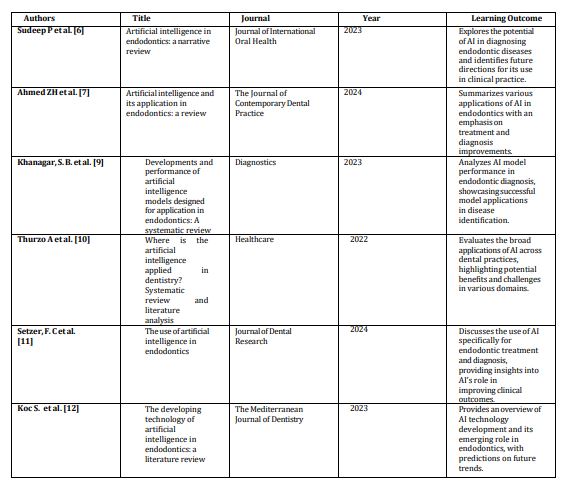
The following studies are focused on the possible use of artificial intelligence (AI) in the field of endodontics regarding improvement in diagnosis, treatment, and overall clinical results.
Sudeep P et al. (2023) look into AI's capabilities for diagnosing endodontic diseases and its future use in clinical settings [6]. Ahmed ZH et. al (2024) give a review of the studies on AI applications within the field, paying attention to how AI assists in increasing diagnosis and treatment of endodontics [7].
Khanagar, S. B. et al. (2023) evaluated the effectiveness of AI models in diagnosing endodontic diseases, with a focus on the successful uses of AI in identification and disease diagnosis [9].
Thurzo A et al. (2022) study shows a more extensive use of AI in dental practices, outlining the advantages and possible drawbacks of AI application in different fields of dentistry [10]. Setzer, F C et al. (2024) wrote about the use of AI in the diagnosis and treatment of endodontic patients, studying how AI can improve clinical outcomes [11].
Koc S. et al. (2023) analyzed the growth of AI and its prospective use in endodontics, making estimates of how AI will be further developed and implemented in this branch of endodontic medicine [12]. Together, these studies offer a thorough examination of AI’s growing influence in endodontics, from diagnosing diseases to improving treatment outcomes, while also showcasing its potential for future advancements Table 1.
Even though AI has significant potential benefits in endodontics, the integration of AI into clinical practice poses a few challenges. After all, the looming problem of adoption of AI in dentistry models as stated by Thurzo et al. (2022) [10] is that vast amounts of data are still not fully available, reliable robust AI models are yet to be developed, and clinicians need to be schooled in its usage. Meanwhile, the more complicated aspect of the problem, the moral facets of using AI for making clinical decisions, must rest on the ways of ensuring that AI is implemented as a supplementary tool rather than an alternative to the expertise of dental professionals.
Advanced trends in machine learning algorithms and AI model performance make the present state of affairs in AI and Automation in Endodontics important and favourable. According to Koc S. et al. (2023) [12], one of the more nuanced systems is expected to work steadily alongside the clinical workflow through the existing interfaces and offer assistance with diagnosis and treatment in real time. Additionally, such systems AI systems can build a case for taking on a wider scope of patient care objectives, like anticipating long-term outcomes and participating in postoperative monitoring, as their capabilities progressively develop.
| Authors | Title | Journal | Year | Learning Outcome |
|---|---|---|---|---|
| Sudeep P et al. [6] | Artificial intelligence in endodontics: a narrative review | Journal of International Oral Health | 2023 | Explores the potential of AI in diagnosing endodontic diseases and identifies future directions for its use in clinical practice. |
| Ahmed ZH et al. [7] | Artificial intelligence and its application in endodontics: a review | The Journal of Contemporary Dental Practice | 2024 | Summarizes various applications of AI in endodontics with an emphasis on treatment and diagnosis improvements. |
| Khanagar, S. B. et al. [9] | Developments and performance of artificial intelligence models designed for application in endodontics: A systematic review | Diagnostics | 2023 | Analyzes AI model performance in endodontic diagnosis, showcasing successful model applications in disease identification. |
| Thurzo A et al. [10] | Where is the artificial intelligence applied in dentistry? Systematic review and literature analysis | Healthcare | 2022 | Evaluates the broad applications of AI across dental practices, highlighting potential benefits and challenges in various domains. |
| Setzer, F. C et al. [11] | The use of artificial intelligence in endodontics | Journal of Dental Research | 2024 | Discusses the use of AI specifically for endodontic treatment and diagnosis, providing insights into AI’s role in improving clinical outcomes. |
| Koc S. et al. [12] | The developing technology of artificial intelligence in endodontics: a literature review | The Mediterranean Journal of Dentistry | 2023 | Provides an overview of AI technology development and its emerging role in endodontics, with predictions on future trends. |
In conclusion, artificial intelligence holds significant potential to revolutionize endodontics by enhancing diagnostic accuracy and treatment planning. While challenges remain in its integration, ongoing advancements in AI technology promise improved clinical outcomes and streamlined workflows. As the field evolves, AI is poised to play a key role in shaping the future of endodontic care. Ethical approval: The Institutional Review Board approval is not required.