Oral Sphere
Journal of Dental and Health Sciences

Journal of Dental and Health Sciences
Received: 2025-06-01
Accepted: 2025-09-25
Published: 2025-10-01
Pages: 210-216
Introduction: Tobacco consumption is a leading cause of death globally, with significant impacts on public health. In India, tobacco use contributes to a substantial loss in GDP and is a major risk factor for various diseases. This study investigates smoking behaviors, attitudes, and health perceptions to understand the factors influencing smoking and attempts to quit. To assess smoking behavior, health perceptions, attitudes towards smoking, and awareness of smoking-related risks in participants, along with the relationship between smoking habits and health. Methods: The study used a voluntary online survey, collecting data on smoking frequency, age of initiation, awareness of smoking risks, and the impact of smoking on oral and general health. The survey also examined participants’ attempts to quit smoking and their motivations for smoking.
Methodology: Data analysis involved descriptive statistics and Chi-square tests to evaluate associations between smoking behaviors and health conditions.
Results: The majority of respondents were non-smokers (73.6%), with most smokers starting in early adulthood. Stress was the primary motivator for smoking among smokers. Awareness of health risks was high (88.7%), but quitting attempts were limited, with a significant number of smokers making fewer than five attempts to quit. Oral health problems were reported by a small number of smokers, with most respondents reporting no issues.
Conclusion: While there is a high level of awareness of the health risks associated with smoking, efforts to quit are limited. Interventions targeting stress and habit-breaking strategies, as well as more inclusive research covering smokeless tobacco, are needed.
The epidemic of tobacco is one of the biggest threats the world has ever faced to public health, killing around 8 million people per year around the world [1]. Furthermore, 7 million deaths are caused by direct tobacco use, while 1.3 million are caused by exposure to secondhand smoke. All kinds of tobacco are injurious to health, but the prevalent one around the world is cigarette smoking [2]. Other forms of tobacco that are used include water pipe tobacco, cigars, heated tobacco, cigarillos, pipe tobacco, kreteks, vapes, and bidis [3].
In a population of 1.3 billion tobacco users worldwide, 80% of them live in developing countries [4]. The detrimental effect on oral health due to tobacco smoking includes both common and uncommon conditions. The benign conditions are as follows: discolouration of teeth, halitosis, impaired wound healing, chemosensory disorders, periodontal disease, mucosal lesions such as smokers' melanosis, smokers' palate, and the malignant condition follows potentially malignant lesions, oral cancer, lung cancer, and various forms of cardiovascular disease [5].
In India, the adult Indian population, i.e, above 15 years of age, is 267 million, among which 29% are tobacco users according to the Global Adult Tobacco Survey (2016-2017). Smokeless tobacco is the most prevalent form of tobacco used in India, along with khaini, gutkha, and betel quid, whereas smoke form includes bidi, cigarette, and hookah. Tobacco is one of the biggest threats to public health worldwide [6]. The attributed cost for tobacco uses in India for all the diseases in the year 2017-18, for people aged 35 years and above, is 27.5 billion USD. India loses 1% of its GDP to disease and early death from tobacco use [7]. Therefore, this study aims to visualise the oral health of tobacco users.
This study aims to assess the following patterns in the participants: smoking behaviour, health perception, and attitude towards smoking. It also explores various aspects, including the frequency of smoking, age of initiation, awareness of health risks associated with smoking, and the impact of tobacco on oral health and general well-being. Mainly, this study examines the relationship between smoking habits and attempts to quit to provide an insight into the factors influencing smoking behavior and cessation.
In this study, the participants voluntarily filled out the online survey concerning their smoking habits and associated health behaviours. It aims to capture data on different smoking patterns, health perceptions, and attempts to quit smoking. The other smoking status, health conditions, and the level of awareness about the risk of smoking in different participants enabled a comprehensive analysis of the topic.
The data collection was done using an online questionnaire that comprised multiple choice questions which mainly focuses on health status, smoking behaviour and awareness of the health risk’s associated with smoking some specific questions also addressed the age of initiation of smoking, alcohol consumption Health’s, factors motivating smoking, daily cigarette consumption, health conditions in post smoking and experience’s with quitting smoking. This study has also collected information on oral health problems linked to smoking and the impact of tobacco on health.
The participants who were willing to engage in the survey were selected, so the purposive sampling method was used for it. Making it accessible to individuals regardless of their smoking status allows for a broad range of responses. This sampling method was selected to gather insights from both smokers and non-smokers, offering a comprehensive view of smoking behaviour across different demographics.
The survey design consisted of a total of 11 key questions for smoking habits and the health perception of the participants. These questions were aimed at general health, smoking frequency, age at which smoking started, factors influencing smoking, alcohol consumption, and awareness of smokingrelated health risks. Further questions focused on the health conditions experienced after starting smoking, the number of attempts to quit, and the impact of tobacco on oral health. Mainly, the responses were categorical, allowing participants to choose from options such as “NEVER”, “occasionally “, “often”, and age range, which helped categorise the respondents' habits and experiences. This study comprises a total of 11 questions, which are used to evaluate different smoking behaviors, triggering factors, awareness, and their effect on general health. The study acquaints us with the effects of smoking on our overall health, its onset, the age of initiation, its frequency, the motivation, alcohol consumption, and the attempts to quit it. Questions also help participants assess the risks associated with them and their impact on overall health, as well as oral health. Therefore, it helps to get a comprehensive understanding of smoking habits and their effects.
Descriptive statistics were used to analyze the collected data to summarize the responses to survey questions by participants. The primary concern was to identify trends in smoking behavior, such as the age of initiation, the frequency of smoking, and common motivations for tobacco. The survey also explores the participants' awareness of health risks, their health conditions related to smoking, and their experiences with attempts to quit smoking. Statistical techniques, With Chi-square tests, were used to evaluate the relationship between smoking status and health conditions. Cross-tabulation was also performed to examine the link between alcohol consumption and smoking frequency.
Ethical standards were adhered to in research, ensuring voluntary participation based on informed consent. Anonymity and confidentiality of responses were assured to the participants. The data collected was used solely for the study, and all personal information was kept secure. The ethical framework was produced to protect participants' privacy and prevent any harm resulting from their involvement in the survey.
A total of 53 participants were surveyed, with 33 rating their health as GOOD (62.3%) and 11 as EXCELLENT (20.7%). 7 of them rated as BETTER (13.2%). And only 1 participant rated his health as WORST (1.9%). The results show that most respondents recognize their overall health positively, expressing satisfaction with their current health status. A total of 53 participants responded to the question, “Do you smoke?” with the majority, 39 participants (73.6%), reporting that they never smoke; 7 participants (13.2%) indicating they smoke often; and 6 participants (11.3%) stating they smoke occasionally, while 1 participant (1.9%) did not provide an answer. These findings suggest that smoking is not a common behavior among most respondents, with nearly three-quarters identifying as non-smokers and only a small proportion engaging in smoking either regularly or occasionally. Out of 53 participants, the majority—35 participants (66%) reported that they have never smoked, while 11 participants (20.8%) indicated they started smoking between the ages of 21– 30, and 3 participants (5.7%) began between 15–20 years old; 4 participants (7.5%) did not provide an answer.
These findings suggest that most respondents have never engaged in smoking, and among the small proportion who have, the majority began smoking in early adulthood rather than during adolescence. Out of 53 participants, 36 (67.9%) reported never consuming alcohol, 13 (24.5%) stated they drink occasionally, 3 (5.7%) indicated they consume alcohol often, and 1 (1.9%) did not provide an answer.
These findings suggest that the majority of respondents abstain from alcohol, with only a small portion consuming it either occasionally or regularly, reflecting generally low levels of alcohol use within the group. Out of 53 participants, only 21 (39.6%) responded to the question about factors motivating them to smoke, while the remaining 32 (60.4%) did not answer, likely because they were non-smokers. Among the responses, stress was the most commonly cited factor by 10 participants (18.9%), followed by habit mentioned by 6 participants (11.3%), social situations by 5 participants (9.4%), and relief by 1 participant (1.9%).
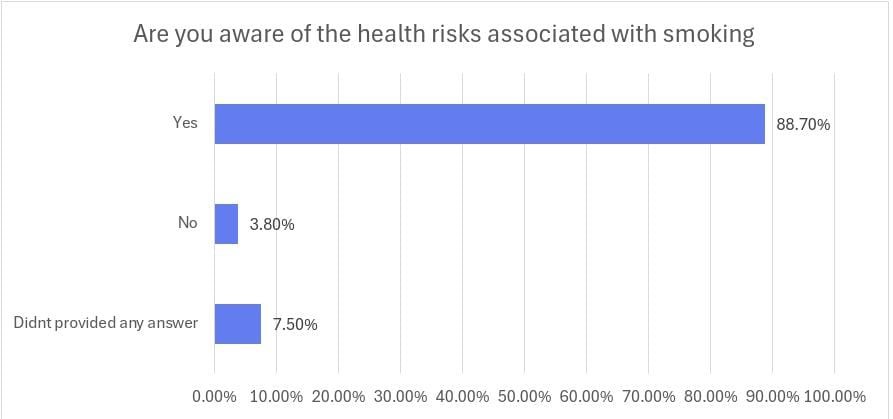
These findings indicate that among those who do smoke, psychological and social factors—particularly stress—are the primary motivators Figure 1. Out of 53 participants, 38 participants (71.7%) reported smoking zero cigarettes per day, indicating that the majority are nonsmokers. Among the remaining participants, 6 participants (11.3%) reported smoking 1–3 cigarettes, 3 participants (5.7%) smoked 5– 7 cigarettes, and another 3 participants (5.7%) smoked more than seven cigarettes per day, while 4 participants (7.5%) did not respond. These findings align with earlier results, showing that smoking is not prevalent among most respondents, and those who do smoke tend to do so at low to moderate levels. Out of 53 participants, 47 (88.7%) responded affirmatively, indicating they are aware of the health risks associated with smoking, while 2 (3.8%) responded negatively, and 4 (7.5%) did not provide an answer.
These findings suggest that the vast majority of respondents have a clear understanding of the dangers linked to smoking, highlighting a generally high level of awareness likely influenced by public health education and anti-smoking campaigns Figure 2. Out of 53 participants, 35 participants (66%) reported “I never smoke”, while 13 participants (24.5%) who have smoked indicated they had not experienced any health conditions after starting smoking, and 2 participants (3.8%) reported that they had developed smoking-related health issues; the remaining 3 participants (5.7%) did not provide an answer.
These findings are consistent with earlier results showing a majority of non-smokers in the sample.
Among smokers, only a small number reported health problems, which may reflect either a lack of symptoms or unawareness of potential health impacts Figure 3.
Out of 53 participants, 35 participants (66%) reported “I never smoke”, while among those who do smoke, 7 participants (13.2%) had attempted to quit 0–2 times, 3 participants (5.7%) reported 3–5 attempts, and 1 participant (1.9%) had tried more than five times; additionally, 6 participants (11.3%) stated “I never tried” to quit, and 3 participants (5.7%) did not provide an answer.
These findings indicate that although most participants are nonsmokers, among smokers, there is some effort to quit, with varying levels of attempts, suggesting both awareness of smoking risks and the difficulties associated with quitting. Out of 53 participants, 39 participants (73.6%) reported no oral health issues after starting smoking, 3 participants (5.7%) responded yes, and 11 participants (20.7%) did not provide an answer. These findings suggest that most respondents have not experienced or are not aware of any oral health problems related to smoking.
However, the small number of reported cases and the relatively high percentage of non-responses may reflect underreporting or limited awareness of the impact of tobacco on oral health Figure 4.
Out of 53 participants, 35 participants (66%) reported “I never smoke”, 11 participants (20.8%) stated no when asked if they had experienced any health issues related to smoking, 3 participants (5.7%) responded yes, and 4 participants (7.5%) did not provide an answer.
These findings suggest that while most participants are non-smokers, only a small portion of smokers believe they have experienced smoking-related health problems, which may indicate either a lack of noticeable symptoms or limited awareness of the long-term health risks associated with smoking.


This study has few limitations that should be acknowledged. The data was self-reported, which can lead to biases, as participants may have provided socially desirable responses rather than reflecting their actual behaviors. Additionally, the sample may not be fully representative of the general population, as it relied on participants who were willing to take part in the survey. Furthermore, specific categories of responses, such as those from non-smokers, were underrepresented, which could affect the generalizability of the findings. Finally, as the survey focused primarily on self- reported data, there may be inconsistencies in participants' responses based on their memory or willingness to provide accurate answers.
This methodology outlines a comprehensive approach to studying smoking behaviors and their impacts on health. It provides valuable insights into the patterns of smoking, the awareness of its risks, and the challenges individuals face in quitting smoking. Despite the limitations, the findings can contribute to a deeper understanding of smoking-related health issues.
This study emphasizes that the majority of participants were non-smokers with awareness of the health risk of smoking, the stress cause, and social factors, which were the key motivators for smokers. Despite high awareness, quitting attempts were limited. To reduce tobacco use, targeted interventions addressing stress and habit-breaking strategies are needed. Further research should include smokeless tobacco users for a more comprehensive understanding.