Oral Sphere
Journal of Dental and Health Sciences

Journal of Dental and Health Sciences
Received: 2025-09-07
Accepted: 2025-11-26
Published: 2026-01-01
Pages: 1-8
Background: It is anticipated that oral & oropharyngeal cancer will continue to rise in the coming decades. Consequently, it is crucial to implement prevention strategies and gain insight into the current state of public awareness and knowledge regarding this ailment. In this context, the field of infodemiology holds a huge significance, as it enables the tracking of trends in health information-seeking behaviours and epidemiology. This study aims to examine and trace the utilisation and progression of internet-based information-seeking behaviours pertaining to head & neck cancer in India, the USA, and across the globe, utilising Google Trends as a primary data source.
Methods: Using Google Trends (GT), the following keywords/terms were searched related to smoking as “cigarette” “, smoking” “, tobacco” “, hookah” and “vape” and oral cancer as “oral cancer” “, mouth cancer” “, throat cancer” “, tongue cancer” and “head and neck cancer”. The search volume and trend were analysed from January 2017 to December 2022.
Results: The Relative Search Volume Index (RSVI) for "vape" was found to be the highest globally, including in the United States. Surprisingly, in India, searches related to cigarette products were more prevalent, while vaping-related searches were the least common among the compared habits.
Conclusion: It is important to know how people look for healthcare information so that we can make sure the information given by health organisations, advocacy groups, and health professionals about head and neck cancers is top-notch and well-planned.
Oral cancer, a global health concern, ranks as the 6th most common cancer in the world. In the year 2020, there were a total of 377,713 newly diagnosed cases, which ultimately led to 177,757 fatalities [1]. Early detection is crucial to prevent the devastating effects of oral cancer. However, smoking and smokeless tobacco stand as the leading causes of this condition. Surprisingly, despite the well-known risks of cigarette smoking, its prevalence remains high, with approximately 933 million smokers worldwide as of 2015. Alarmingly, 80% of these smokers reside in low- and middle-income countries [2].
While oral cancer incidence is higher in men, an unexpected surge in cancer arising from the tongue among younger women lacking any tobacco/alcohol practice [3]. The reasons behind this trend, whether it stems from an exclusive appearance of oral cancer, remain undetermined [4]. Oral cancer comprises 12% of the total cancer cases in males and 8% of the total cancer cases in females [5].
It is crucial to recognise that cigarette smoking not only contributes to oral cancer but also escalates the risk of various other cancers. Nicotine, leading to addiction and habit formation, along with the presence of numerous cancer-causing agents in the smoke, is accountable for the detrimental effects of cigarette smoking [6].
Understanding the grave consequences of smoking and its association with oral cancer is pivotal in raising awareness, implementing prevention strategies, and promoting early detection [7]. By shedding light on the harmful effects and global prevalence of smoking, we can foster a sense of urgency in addressing this public health crisis. Through comprehensive research and targeted interventions, we strive to mitigate the devastating impact of smoking-related oral cancer on individuals, communities, and societies worldwide [8].
Observing the increased awareness of oral cancer & oropharyngeal cancer, reflected in various platforms, including websites, alongside a slight decrease in its incidence, highlights the significance of the Internet as the primary basis of health evidence for many patients and the general population [9]. Health-related searches constitute approximately five per cent of searches on Google, which is the world's utmost prevalent search engine [10]. To assess the level of interest among the general populace in medical conditions, researchers frequently utilise Google Trends, a freely accessible online search platform that quantifies the collective interest in various subjects by analysing search queries pertaining to specific terms across diverse geographic regions and languages [11].
The analysis of online search queries, particularly through Google Trends, has gained popularity in academic research for its ability to leverage big data analytics. However, when it comes to head & neck cancer, there is a lack of specific data, as most studies have focused on oral cancer as a secondary outcome [12]. Nonetheless, some studies have identified a recent increase in search interest related to oral cancer [13].
Notably, searches for oral cancer significantly surge during specific periods of the year, aligning with the influence of "Oral Cancer Awareness Month" in May. In this study, we aim to investigate the awareness of oral & oropharyngeal cancer and its association with risk factors by analysing Google Trends search data over the past five years.
We performed a systematic inquiry utilising Google Trends, employing the search terms related to smoking as “cigarette” “, smoking” “, tobacco” “, hookah” and “vape”. Consequently, we also searched for terms related to oral cavity cancer, such as “oral cancer”, “mouth cancer”, “throat cancer”, “tongue cancer”, and “head and neck cancer”. Comparative search was done for the Worldwide, the United States of America and India. A custom data range was selected from 1 January 2017 to 31 December 2022 to determine the volume of search. The Google Trends application was used in the browser to determine the Relative Search Volume Index (RSVI), which depicts the number of searches of a specific term at that point in time relative to the total number of searches, scaled from 0 (minimum) to 100 (maximum). The data was extracted from Google Trends into CSV Excel spreadsheets. Furthermore, year-wise and month-wise mean was calculated for various habits as well as various oral cancer-related terms for different regions
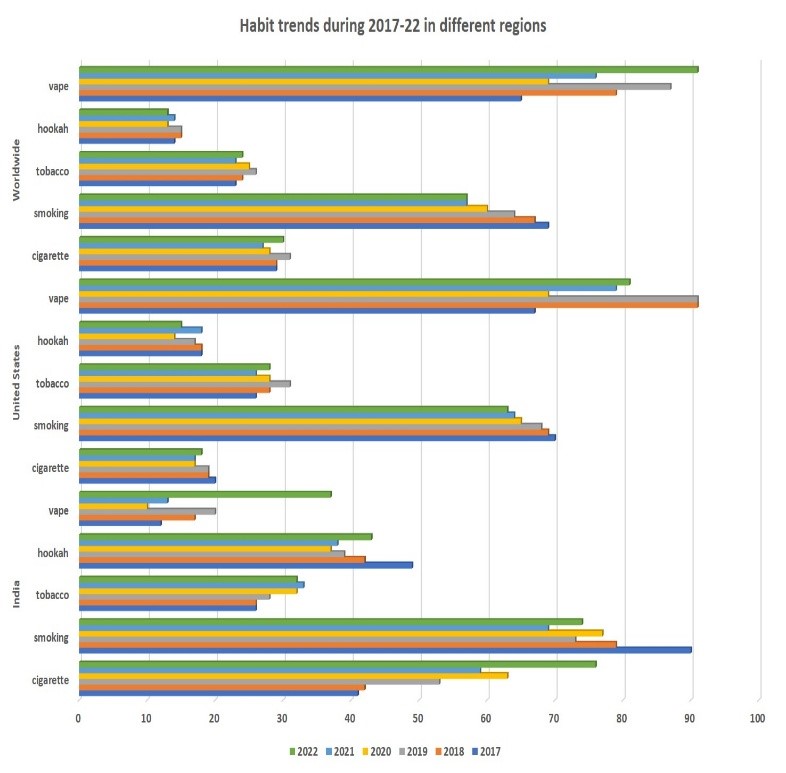
The trend analysis of habit-related searches from 2017 to 2022 uncovered some interesting patterns. The Relative Search Volume Index (RSVI) for "vape" was found to be the highest globally. Surprisingly, in India, searches related to smoking were more prevalent, while vaping-related searches were the least common among the compared habits.
Globally, the RSVI for hookah, tobacco, and cigarettes remained relatively constant throughout the analysed period. However, there was a decreasing trend in searches related to smoking, with the highest search volumes in 2017 and the lowest in 2022. On the other hand, there was a consistent upward trend in searches related to vaping since 2017.
In the United States, the most searched habit was vaping. Notably, there was a significant surge in searches related to vaping in 2018 and 2019. Conversely, the trend for smoking-related searches showed a consistent decline over the years. Hookah, tobacco, and cigarettes maintained a similar level of RSVI throughout the analysed period.
In India, it was striking to find that smoking and cigarette-related searches dominated the overall search trends. There was a slight decline in searches related to smoking since 2017. However, both vaping and cigarette searches exhibited a sharp rise from 2017 to 2022. Hookah and tobacco searches remained relatively consistent in terms of RSVI during these years Figure 1.
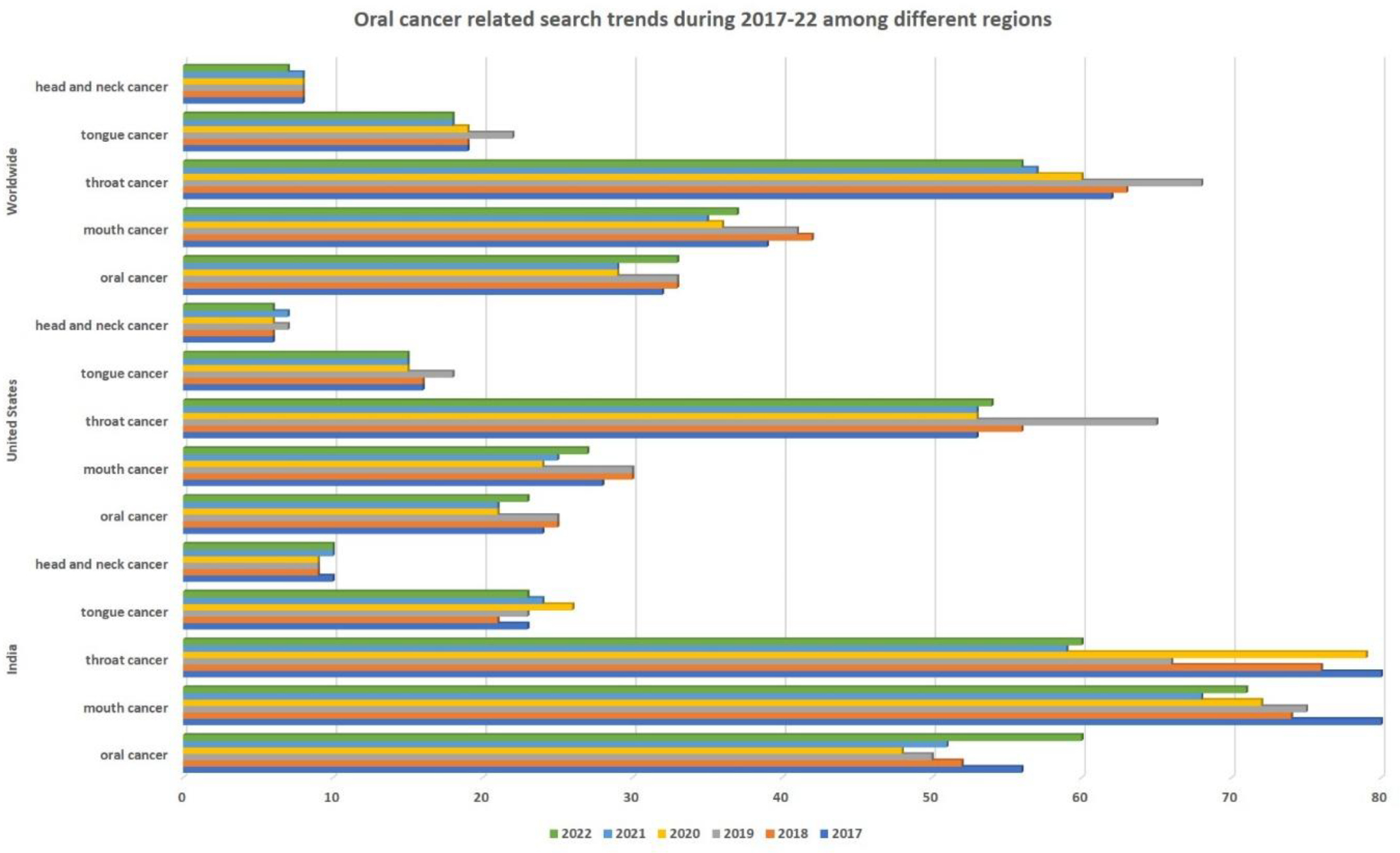
Regarding oral cancer-related searches from 2017 to 2022, it was evident that "throat cancer" was a widely searched term globally, as well as in the United States. However, in India, alongside throat cancer, "mouth cancer" emerged as the most searched term. There was a downward trend observed in searches related to throat cancer and mouth cancer since 2017. Interestingly, there was a sharp increase in oral cancer-related searches specifically in the year 2022 Figure 2.
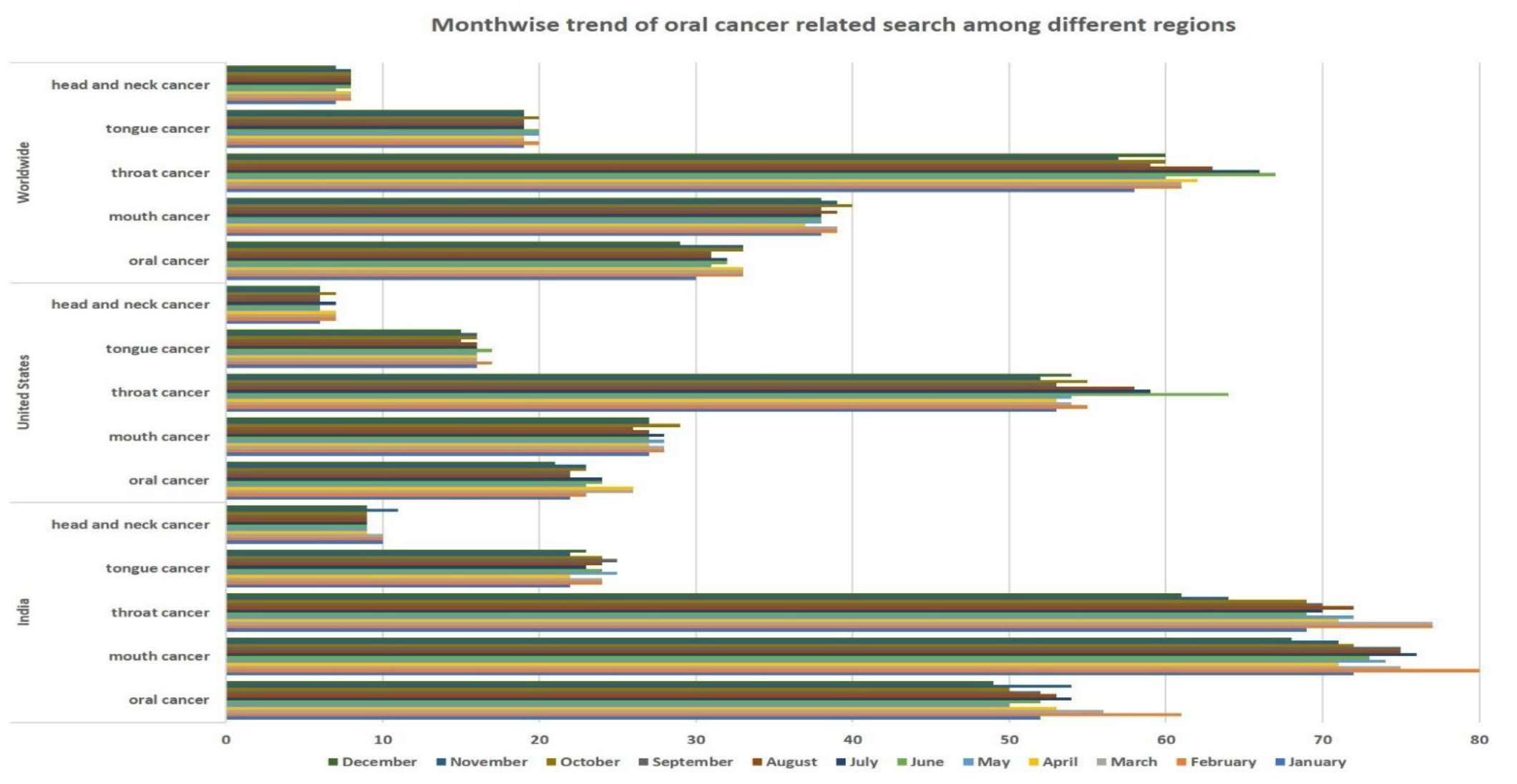
When analysing the month-wise trends of oral cancer-related searches across different regions, it became apparent that "throat cancer" was the most searched term in June, both in the United States of America (USA) and worldwide. In India, during February, the highest RSVI was observed for searches related to throat cancer, mouth cancer, and oral cancer Figure 3.
Turning our attention to the month-wise trend analysis of habit-related searches, it was found that the RSVI for vaping reached its peak in December and August in both the United States and worldwide. However, in India, vaping-related searches were highest only in December.
In terms of smoking-related searches, the RSVI reached its highest point in January and April globally, whereas for the United States, it was highest in April and November. In India, the peak for smoking-related searches occurred in March.
Notably, tobacco-related searches showed a different pattern. The highest RSVI for tobacco searches was observed in May worldwide and in India, but for the United States, it reached its peak in December. Additionally, in India, there was a noticeable trend of a sharp rise in searches related to hookah during December and January. As for cigarette searches, the highest RSVI was recorded in September in India. Figure 4.


Lack of public awareness about cancer can lead to delayed presentation and lower survival rates. However, awareness campaigns have the potential to enhance knowledge, raise awareness, and prompt earlier interventions [13]. In our study, we utilised Google Trends to analyse online behaviours concerning oral cancer along with associated risk factors. This type of analysis has also been applied to smoking and lung cancer research.
Cancer that develops on various sites of the oral cavity, such as the lips, anterior 2/3rd of the tongue, ventral surface of the tongue, hard palate, buccal mucosa & floor of the mouth, is termed oral cancer (Oral squamous cell carcinoma) [14]. Conversely, cancer located in the middle part of the pharynx, which includes the vertically area from the soft palate to the superior location of the hyoid bone and includes the base and posterior one-third of the tongue, the tonsils, soft palate, and posterior and lateral pharyngeal walls referred to as oropharyngeal cancer (Oropharyngeal squamous cell carcinoma) [8].
Head and neck cancer constitutes a set of malignant tumours located in regions like the oropharynx, larynx, hypopharynx, nasopharynx, and oral cavity. These cancers collectively contribute to approximately 800,000 new cases annually, resulting in approximately 400,000 deaths [9]. Among these cancers, oropharyngeal cancers hold prominence. While conventional risk factors include tobacco and alcohol drinking, it has been solidified that human papillomavirus (HPV) has a significant role in the development of oropharyngeal squamous cell carcinomas (OPSCC) [10].
The recent "WHO 2022" classification introduces a distinct stratification of oropharyngeal cancers based on their HPV association. This classification highlights the division between HPV-associated and HPV-independent OPSCCs.11 HPV is identified in about 20% to 60% of OPSCCs, with its prevalence varying based on geographic location. Noteworthy is the significant variation in the proportion of HPV-associated OPSCCs, ranging from 10–20% in Asia to 60–80% in North America and Northern Europe [9].
Characteristic of patients with HPV-associated OPSCCs is a higher prevalence among males (with a male: female, 4:1), Caucasian ethnicity, in addition a more elevated socioeconomic status. While HPV-associated OPSCCs are further prevalent among nonsmokers, prevalence significantly varies among countries, with smoking rates exceeding 60% in certain regions. Another notable aspect is sexual practice, particularly oral sex, which emerges as a significant risk factor for HPV-associated OPSCCs. Outcomes also differ between these two categories. HPV-associated OPSCCs generally exhibit a more favourable prognosis compared to HPV-independent cases. These cancers tend to respond better to radiation treatment and demonstrate improved overall survival rates [13].
Interestingly, our findings revealed that "vaping" was the most frequently searched term. E-cigarettes have evolved from traditional cigarette-like designs to compact, pod-based devices with pre-filled cartridges, particularly popular among the youth. This shift may contribute to the recent surge in their usage. Notably, the nicotine content in various e-liquids varies from 15 to 50 mg/mL. This exposure to nicotine places adolescents at risk of toxicity and potential overdose due to their rapid absorption of high nicotine amounts within a short period [14].
Excessive nicotine consumption using a vape may result in nicotine toxicity, manifesting as symptoms such as headaches, abdominal pain, nausea, vomiting, heart palpitations, hand tremors, difficulty concentrating, and in severe cases, seizures and cardiac arrhythmias. Furthermore, nicotine constitutes a prolonged risk factor for the deterioration of cardiovascular health [15].
Exposure to passive smoking and its addiction adds to the health and environmental hazards, which might be correlated to waterpipe use. In particular, the risk factors related to environment and daily habits lead to oxidative stress and therefore can be more harmful to smokers who use waterpipe tobacco [16]
Tobacco products remain the cause of high morbidity and mortality. Reducing the addition of nicotine in cigarette making to the least possible level of addiction might aid in decreasing the prevalence of smoking cigarettes. Moreover, it would significantly lower the course of tobacco users who are vulnerable to the habit, thereby increasing the cessation of smoking tobacco amongst habitual smokers. In addition, facilitating the availability of electronic cigarettes (e-cigarettes) plays a significant role as a "harm reduction" product, in order to reduce the intake of conventional cigarette smoking amongst youth [17].
The U.S. Food and Drug Administration have been meticulously surveilling the presence of carcinogens in tobacco as well as tobacco smoke. Numerous data have been published since the year 2012, vis-à-vis the presence and levels of carcinogens in tobacco products, exhibiting a total of 83 carcinogens. Close observation and prior actions need to be taken for checking the quality of tobacco products to corroborate significantly lower levels of carcinogens, so as to mitigate the probable risk of cancer and other diseases [18].
Several trials, using Google Trends to analyse population interest in oral cancer within different time frames, have demonstrated time trends and seasonal patterns [19],[20]. Tabuchi et al. [21] conducted a study investigating the influence of tobacco price surges on smoking cessation attention in Japan from 2004 to 2016. They concluded that an increase in cigarette price increments had a stronger and more long-term outcome on curiosity in quitting, although the impression might diminish over time.
Insights into smoking-related behaviour data can be harnessed to gauge the extent and extent of outcomes stemming from tobacco preventive strategies. Smoke-free regulations, for instance, can bolster the intention to quit smoking by fostering a greater mindfulness of the ill effects associated with smoking, along with supporting undesirable societal attitudes towards it. This cumulative effect might result in a sustained inclination toward smoking cessation with long-term consequences [19].
These search behaviour trends offer valuable insights into the evolving interests and concerns of individuals concerning oral cancer and various habits like vaping, smoking, tobacco, hookah, and cigarettes. By comprehending these patterns, we can more effectively tailor awareness campaigns and public health interventions to address specific needs during different periods of the year. Knowledge about the timeframe throughout which tobacco preventive strategies impact smoking termination behaviour and its predecessors can enhance the execution of these guidelines. Identifying moments when smokers are further inclined to plan quitting provides strategic windows for interventions targeting those individuals.
One of the limitations of this study is that internet usage is more prevalent among younger, more educated, and higher-income individuals. Google Analytics merely serves as a "proxy" for actual population-level behaviour and does not precisely mirror real behaviour. However, despite these limitations, Google Trends remains a cost-effective, real-time, reproducible, and globally accessible tool that validates existing information.
Every study has its limitations, and this one is no different. So, in order to find one of the biggest issues, we have to go with the timeframe and the fact that the study focuses on Google Trends. This is an internet-based tool, and in order to be effective, the users should be of an older population, but also, the things they're educated about should be on the other end of the income spectrum. Also, Google Trends is a bit of a "proxy" for behavior, meaning that it doesn't fully capture people's actions and attitudes about things like smoking and awareness of cancer. On top of that, the study's scope is limited to certain regions and a fixed timeframe of 2017 to 2022, which doesn't take into account current and more recent changes in public interest. So, even with all this, Google Trends is still one of the best options we have for this research.
Another objective of this study is to broaden the research interest regarding oropharyngeal and oral cancers. This will be accomplished by adding and analyzing new data from other regions and by lengthening the study periods to be able to assess the study trends over time.
Future works may also fine-tune the approach to studying global health information-seeking behaviors by incorporating other demographic variables like age, education, and social standing, so that research work will be more conclusive. Besides, there is an interest to assessing the effect of particular awareness initiatives like “Oral Cancer Awareness Month” on interest and awareness of the public. Also, the role of social media as a health innovation on public knowledge is worth studying. The study might as well correlate search trends to actual health variables such as cancer incidences and/or smoking cessation. The more public health resources and efforts are spent to educate the public regarding oral and oropharyngeal cancers, the more infodemiology will be useful.
Vaping is gaining popularity, particularly among young individuals, while smoking rates are on the decline. Nevertheless, a significant number of people continue to smoke. Head & neck cancer, a severe health concern, can be attributed to smoking, vaping, and other habits. Although awareness of oral & oropharyngeal cancer is increasing, further efforts are needed. This study provides valuable data on habit-related search trends and head & neck cancer. These insights can inform the development of effective awareness campaigns and public health interventions aimed at addressing these critical public health issues.