Oral Sphere
Journal of Dental and Health Sciences

Journal of Dental and Health Sciences
Received: 2025-09-07
Accepted: 2025-11-15
Published: 2026-01-01
Pages: 17-21
Background: Sexual and reproductive health among youth is a major public health issue in sub-Saharan Africa. This population group, undergoing biological, psychological, and social transitions, is particularly vulnerable to sexually transmitted infections (STIs), HIV/AIDS, and unintended pregnancies. Several interrelated factors exacerbate this vulnerability: early sexual initiation, lack or inadequacy of structured sex education, stigmatization of preventive behaviors, and unequal access to protective means, particularly condoms. Despite efforts by health authorities and international partners to promote condom use, its prevalence remains paradoxically low among the most exposed groups. In university settings, this issue is particularly significant: young adults develop autonomy and explore their sexuality, often without proper guidance or adequate information. Many barriers, cultural, psychological, or institutional, still hinder consistent condom use, despite its proven effectiveness in preventing STIs, HIV/AIDS, and unplanned pregnancies. In this context, it is essential to identify the determinants of condom use (or non-use) to guide prevention policies tailored to the socio-cultural realities of young people in sub-Saharan Africa, particularly in Burundi.
Methodology: A cross-sectional, descriptive, and analytical study was conducted in April 2025 at the University of Lake Tanganyika in Burundi. It involved a sample of 196 students selected through non-probability convenience sampling due to the lack of a nominative database. The main objective was to identify sociodemographic, sociocultural, behavioral, and cognitive factors influencing condom use among university students. Data were collected via a structured face-to-face questionnaire covering sexual practices, preventive attitudes, and knowledge of sexual and reproductive health. Data were entered and analyzed using Microsoft Excel and SPSS version 25. Statistical analysis was based on bivariate tests with calculation of Odds Ratios (OR) and 95% Confidence Intervals (CI) to assess the strength and significance of associations between the dependent variable (condom use) and the independent variables. Statistical significance was set at p < 0.05
Results: The prevalence of condom use was 44.4%, with significant determinants identified as place of upbringing (OR = 4.136; p < 0.001), shame in purchasing condoms (OR = 3.009; p < 0.001), knowledge of condom benefits (OR = 5.856; p < 0.001), and knowing someone who died from AIDS (OR = 4.741; p < 0.001).
Conclusion: Strengthening communication and education on sexual health is necessary, particularly to break taboos and promote condom use.
Youth sexual and reproductive health is a global public health priority, especially in sub-Saharan Africa, where morbidity and mortality indicators related to STIs, HIV/AIDS, and early pregnancies remain concerning [1]. Young people, especially students, often engage in sexual discovery without adequate tools to protect themselves [2]. This situation is worsened by a lack of sexual education, stigma surrounding contraceptive use, and low accessibility to protective methods [3].
Universities serve as spaces of socialization and transition to adulthood, where sexual behaviors evolve under peer pressure, experimentation, and growing autonomy. However, they rarely offer structured support on sexual health [4]. The absence of appropriate services, such as health centers or confidential dialogue spaces, contributes to youth sexual insecurity [5]. Negative social perceptions surrounding condoms as symbols of mistrust or promiscuity hinder acceptance, even in stable relationships [6].
Understanding the individual and collective logic behind these behaviors is essential to design relevant prevention strategies that respect local cultural dynamics [7].
In Burundi, data show that youth engage in sexual activity increasingly early, with heightened risk of exposure to HIV/AIDS and other STIs [8].
Despite the availability of condoms, usage remains low, prompting public health professionals to understand the socio-cultural, economic, and cognitive reasons behind this trend [9]. This study, therefore, empirically explores the determinants of condom use among university students.
Type, Location, and Study Period: This was a cross-sectional analytical study conducted at the University of Lake Tanganyika, a higher education institution hosting students from diverse socio-cultural backgrounds. The cross-sectional design allows for a snapshot of the current situation and the exploration of potential associations between variables.
Population and Sampling: The study targeted students officially enrolled during the 2023–2024 academic year. A non-probabilistic convenience sampling method was used due to the absence of a nominative student registry. The sample size was determined using Schwartz's formula, with 196 participants, ensuring sufficient statistical power for an exploratory study.
Data Collection: Data were collected through a structured, face-to-face questionnaire covering sociodemographic, sociocultural, behavioral, and knowledge-related dimensions. Anonymity and confidentiality were ensured to promote honest responses.
Variables:
Dependent variable: Condom use (yes/no)
Independent variables:
Sociodemographic: Age, sex, origin
Sociocultural: Religion, Rumours, Shame
Economic/behavioural: Perceived cost, Accessibility, Alcohol use
Knowledge: Definitions, benefits, Indirect experiences (e.g., knowing someone who died of AIDS)
Conceptual Framework
This framework conceptualises the factors influencing condom use, organized into four main categories: knowledge-related factors, sociodemographic factors, sociocultural factors, and behavioral factors.
An individual’s knowledge and understanding of condom use and its benefits can significantly influence their adoption.
Knowledge of condom use: Familiarity with the proper use and techniques of condoms is crucial for effective protection.
Knowledge of the benefits of condoms: Information about how condoms help prevent sexually transmitted infections (STIs) and unintended pregnancies can encourage their use.
Knowledge of someone who has died from AIDS: Awareness of the severe consequences of AIDS, particularly through personal connections, can increase motivation to use protection.
An individual’s personal and social characteristics can impact their behaviors and decisions regarding condom use.
Age: Age can play a significant role in attitudes and behaviors related to sexual health and condom use.
Origin (Urban/Rural): An individual’s place of origin (urban or rural) can influence access to condoms and cultural attitudes toward their use.
Sex: Gender differences can affect the perception, control, and negotiation of condom use in sexual relationships.
These factors are related to cultural beliefs, religious teachings, and social norms that shape sexual behaviors.
Religion: Religious beliefs may either support or restrict condom use based on moral teachings.Shame of purchasing: The embarrassment or stigma associated with buying condoms in certain societies may deter their use.
Rumors: Misinformation or rumors about the effectiveness and safety of condoms can create barriers to their use.
Individual choices and behaviors directly affecting condom use are also crucial determinants.
Cost of condoms: The price of condoms can be a barrier, especially in low-income populations.
Availability of condoms: Access to condoms, whether easily or limited, plays a significant role in their use.
Alcohol or drug use: Consumption of substances like alcohol or drugs can impair judgment and reduce the likelihood of condom use
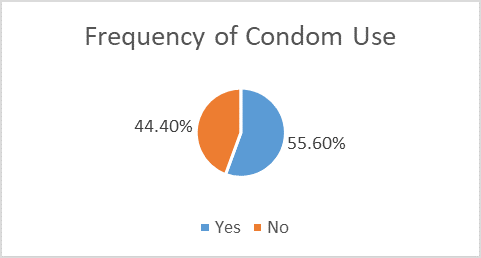
Regarding the frequency of Condom Use among Students at the University of Lake Tanganyika in Burundi, 44.4% of the 87 students, or 44.4%, were in favor of condom use, compared to the 55.6% who were against it Table 1, Figure 1.
The results in this study show that 112 (or 57.1%) were under 21 years old, 87 (or 44.9%) lived in an urban area, and 95 (or 48.5%) were married Table 2.
The study shows a statistically significant relationship between the environment of development and condom use, meaning that those who grew up in an urban environment are 4.1 times more likely not to use a condom compared to those who grew up in a rural environment, with a probability of 0.001 Table 3.
We conclude that the observed differences are statistically significant, and the hypothesis that the environment influences condom use is accepted.
| Use | Frequency | Percentage |
|---|---|---|
| Yes | 87 | 44.4% |
| No | 109 | 55.6% |

| Variable | Category | Frequency | Percentage |
|---|---|---|---|
| Age | >21 yrs | 112 | 57.1% |
| ≤21 yrs | 84 | 42.9% | |
| Place of origin | Urban | 87 | 44.9% |
| Rural | 109 | 55.6% | |
| Sex | Male | 95 | 48.5% |
| Female | 101 | 51.5% |
| Factor | OR | 95% CI | p-value |
|---|---|---|---|
| Urban vs rural origin | 4.136 | [2.270–7.535] | <0.001 |
| Shame in buying condoms | 3.009 | [1.632–5.550] | <0.001 |
| Knowledge of benefits | 5.856 | [3.048–11.250] | <0.001 |
| Knowing AIDS-related death | 4.741 | [2.580–8.714] | <0.001 |
In our study, 44.4% were in favor of condom use. Our results are similar to those found by Otim B et al. (2024) in his research on the determinants of condom use among among Undergraduate Students of Gulu University, Uganda regarding the prevention of HIV/AIDS, STIs, and unwanted pregnancies: the case of the Kiriri campus of the University of Burundi, where he reported that about 50% of students were in favor of condom use.
The results of our study indicate that 87 students (44.9%) resided in urban areas, while 109 students (55.6%) lived in rural environments. Upon further analysis, it was found that individuals who grew up in urban settings were 4.1 times more likely to avoid condom use compared to their rural counterparts, with a statistically significant probability of 0.000. This aligns with the results of AH Talema et al. (2023) [11].
The meta-analysis of Izudi et al. (2022) [12] included 44 studies involving 27,948 participants found that 52.9% of sexually active university students in sub-Saharan Africa used condoms during their last sexual intercourse. The study highlighted that condom use was not significantly associated with sex, age, or condom negotiation efficacy which is similar to our results.
A study conducted at Gulu University by Otim et al. (2024) [13] reported that just over half of undergraduate students used condoms in their sexual encounters in the past six months. Factors such as male sex, nature of sexual relationship, place of HIV testing, and having sex in the absence of condoms were significantly associated with consistent condom use.
The study by Jimu et al. (2023) [14] found a low prevalence (27.1%) of condom use among youth in Malawi during their last sexual intercourse within four months before the survey. Male youth were more likely to use condoms than female youth, and factors such as being sexually active, aged 20–24, ever married, coming from central or southern regions, residing in rural areas, and ever testing for HIV were significant predictors of condom use.
A study by McCarthy et al. (2024) [15] focusing on South African female students identified personal factors, such as knowledge about sexual reproductive health, as influencing consistent condom use. The study emphasized the need for targeted interventions to address these factors
This study had certain limitations. The sample size was smaller than in some previous trials, and the questionnaire used was limited to closed-ended questions, which may have restricted the depth of patient feedback. Moreover, the study duration was limited to six months, whereas long-term follow-up is essential to evaluate stability and survival outcomes thoroughly. Future research should also assess the periodontal health implications of various retainers, as these may influence clinical recommendations.
This study shows that condom use among university youth remains insufficient and is influenced by multiple factors. Integrated interventions combining sexual health education, increased access to protection, and breaking of taboos are essential.