Oral Sphere
Journal of Dental and Health Sciences

Journal of Dental and Health Sciences
Received: 2025-09-07
Accepted: 2025-10-26
Published: 2026-01-01
Pages: 30-35
Background: Chronic urticaria (CU) is defined by the presence of recurrent wheals, angioedema, or both for more than six weeks. In the absence of identifiable triggers, it is termed as chronic spontaneous urticarial (CSU). Several systemic conditions, including thyroid dysfunctions, are implicated in CSU, making early diagnosis crucial for effective management.
Case Presentation: The authors present the case of a 30-year-old female dentist who reported with recurrent facial urticaria refractory to antihistamines. Medical history revealed previously diagnosed hypothyroidism for which she had discontinued levothyroxine on her own. Laboratory investigations revealed elevated TSH and low free T3/ T4 levels, confirming primary hypothyroidism. Other causes: autoimmune thyroiditis, infection, anemia, systemic conditions were ruled out, and the patient was referred to an endocrinologist. On restarting levothyroxine, complete, sustained remission was achieved.
Conclusion: Facial urticaria, though unusual, may be the only presenting feature of CSU. It should prompt clinicians, especially dental practitioners, to consider systemic associations. Early recognition, a multidisciplinary approach, and targeted therapy for the underlying condition help in achieving remission.
Urticaria is a common dermatological condition marked by transient, pruritic wheals with or without angioedema. When symptoms extend beyond six weeks, the condition is termed chronic urticarial (CU). CU is further classified as inducible (triggered by physical or environmental factors) and spontaneous (no external trigger identified). Chronic spontaneous urticarial (CSU) comprises the majority of CU cases (approximately 70-80%) and is characterized by unpredictable flare-ups that significantly affect patients’ quality of life [1]. The estimated global prevalence of CSU is around 0.5 to 1%, with a higher incidence in females and typical onset in the third to fourth decade of life [2]. Beyond discomfort, CSU is associated with sleep disturbance, psychiatric comorbidities, impaired daily functioning, and healthcare burden.
The pathophysiology underlying CSU remains incompletely understood but is thought to involve mast cell and basophil activation with resultant histamine and other mediator release [2]. Autoimmune mechanisms have been implicated, including the presence of auto-antibodies to IgE or its high-affinity receptor, dysregulation of T-helper cell subsets (e.g., Th17/ Treg imbalance), and elevated pro-inflammatory cytokines (e.g., IL-6, TNF-α). These immune mediators may sustain or amplify the urticarial response and render standard therapy (anti-histamines) less effective in some patients [3].
One of the most consistent systemic associations observed in CSU is with thyroid disease, particularly autoimmune thyroiditis and hypothyroidism. The prevalence of thyroid auto-antibodies (anti-thyroid peroxidase [anti-TPO]), anti-thyroglobulin (anti–TG), and abnormal thyroid hormone levels is higher among CSU patients than in healthy controls [3]. A recent case-control study by Golusin et al. found that among CSU patients vs healthy controls, hypothyroidism was present in 27.9%, anti-TPO in 51.2%, and anti-TG in 41.9% CSU patients, confirming a strong association between CSU and thyroid abnormalities [4].
Another study aimed to explore thyroid autoimmunity as a potential marker of treatment response. It examined the presence of anti-TPO IgG in relation to response to Omalizumab and found that thyroid autoimmunity alone could not predict treatment outcome [5]. This suggests that while thyroid markers are common in CSU, they may not serve as reliable prognostic indicators in isolation.
Treatment of thyroid dysfunction, particularly hypothyroidism, may improve CSU outcomes. Case series and observational studies report improvement or even complete remission of urticaria after initiating levothyroxine therapy in hypothyroidism patients [3],[6]. Also, better urticaria control was observed when the underlying thyroid disorder was addressed, further reinforcing the clinical importance of this association [4]. Current guidelines and consensus documents recommend considering thyroid function testing in patients with difficult-to-treat CSU [1]. Early identification and treatment of thyroid dysfunction may reduce disease refractoriness, improve patient quality of life, and potentially shorten disease duration.
Therefore, this case report is important to determine the role of thyroid dysfunction in refractory CSU, to document how levothyroxine-induced restoration of euthyroid status may lead to remission, and to emphasize the need for inter-disciplinary awareness in managing CSU.
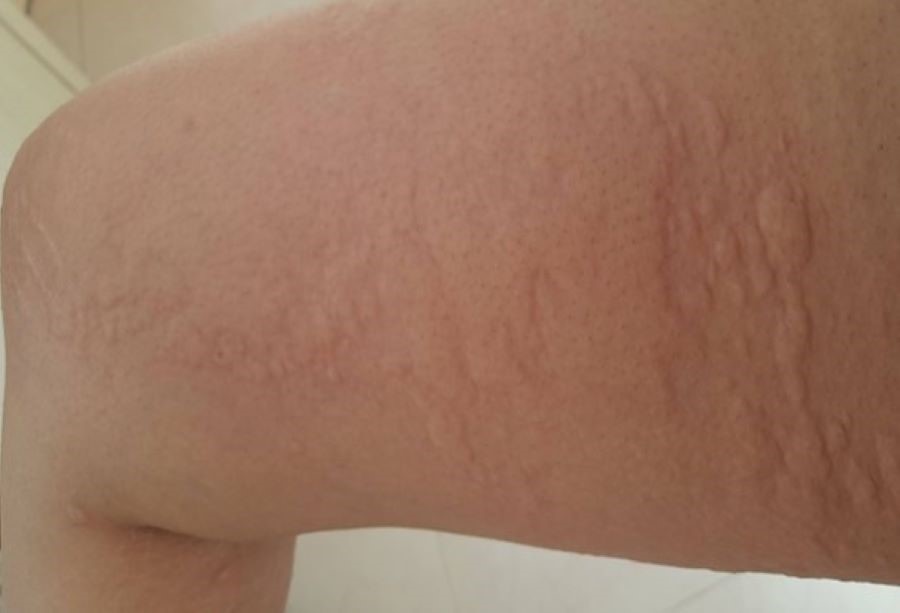
A 30-year-old female, a dentist by profession, reported to the Department of Oral Medicine and Radiology with a chief complaint of itching and intermittent swelling of the face for the past 15 days. A year earlier, she experienced recurrent episodes of hives on her legs, which she initially attributed to mosquito bites and did not seek treatment Figure 1. Over time, the hives became more frequent, widespread, and appeared on her arms and thighs as well Figure 2. These were accompanied by intense itching, which aggravated the condition. The hives also occurred at night, disturbing her sleep. Recently, hives began appearing when carrying weight (e.g., a bag on her shoulder).

(Note: discrete hives)
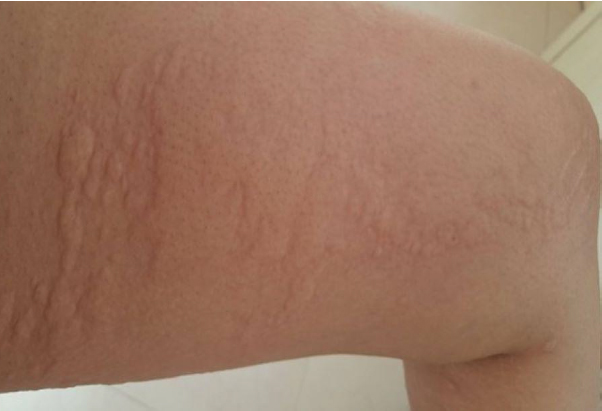
(Note: Concomitant angioedema associated with the hives)
She sought dermatological care, where she was diagnosed with chronic inducible (delayed pressure) urticaria and prescribed levocetirizine 10mg (hs) and calamine lotion for 15 days, resulting in temporary relief. However, after 20 days, the hives reappeared.
Despite maintaining an “urticaria diary”, no specific triggers could be identified. She then consulted a homeopathic practitioner, but without any significant relief. Over the last 15 days, she developed itching and wheals on her face. As with previous outbreaks, the hives were sudden in onset and accompanied by intense itching. Further history revealed that she had been diagnosed with hypothyroidism two years earlier and was on levothyroxine 100mcg. However, she had discontinued the medication on her own the previous year after adopting a healthier lifestyle and experiencing some symptom improvement.
On general examination, the patient appeared overweight, with no evidence of hives on the body. Both extra-oral and intra-oral examinations were normal. Given the chronic nature of the urticaria and the absence of identifiable triggers, acute urticaria (due to food, drug, or pollen allergies), fixed drug reaction, and inducible chronic urticaria (triggered by heat, cold, or pressure) were ruled out. A provisional diagnosis of facial urticaria as a manifestation of chronic spontaneous urticaria (CSU) was made.
A comprehensive blood evaluation (routine investigation, hormonal, and vitamin profile) was prescribed. The results showed high TSH and low free T4/T3 levels, indicating primary hypothyroidism. Thyroid Peroxidase antibody test was negative, eliminating Hashimoto’s thyroiditis. CBC and HbA1c were within limits, ruling out anemia and DM Table 1.
| Test | Patient value | Reference range |
|---|---|---|
| TSH | 109uIU/ml | 0.5-4.7 |
| T3 | 0.79ng/ml | 0.7-2.0 |
| T4 | 6.51ug/ml | 5.7-13.0 |
| Free T4 | 0.3ng/dl | 0.8-1.8 |
| Free T3 | 0.6ng/ml | 1.4-4.4 |
| HbA1c | 5.4% | 4-6 |
| Hb | 11.0g/dl | 11-15 |
| Anti-TPO | 0.68IU/ml | <5.61 |
ESR and CRP levels were normal, excluding an infective etiology. The patient was referred to an endocrinologist who prescribed levothyroxine 75microgram. After just one week, the number, frequency, and intensity of the hives began to reduce. Within two months, the patient was completely symptom-free, her facial urticaria resolved, and her thyroid profile returned to normal Table 2. The final diagnosis was confirmed as facial urticaria secondary to primary hypothyroidism. At a one-year follow-up, the patient had achieved complete remission with no recurrence to date.
| Test | Patient value | Reference range |
|---|---|---|
| TSH | 1.03uIU/ml | 0.5-4.7 |
| Free T4 | 1.50ng/dl | 0.8-1.8 |
| Free T3 | 3.07ng/ml | 1.4-4.4 |
| Author/Year | Patient detail | Systemic condition | Outcome |
|---|---|---|---|
| Gowda & Doddabasappa 2024 [12] | 13 y/o female with painful urticarial wheals | AITD with urticarial vasculitis | Diagnosed with urticarial vasculitis |
| Shivaraju et al. 2021 [13] | 54-year-old male with chronic lip swelling | AITD with angioedema | Partial remission after levothyroxine therapy |
| Yuan et al. 2019 [7] | 14 y/o male with refractory CSU | Vitamin D insufficiency | Complete remission after vitamin D supplementation |
| Tadros et al. 2018 [8] | 19 y/o male with refractory CSU | Odontogenic infection | Urticarial resolved after treatment of the offending tooth |
| Shahbaz et al. 2018 [10] | 54 y/o female with recurrent CU | AITD Positive anti-TPO Positive anti-TG | Complete remission with levothyroxine therapy |
| Manganoni AM 2007 [14] | Four females with CU | Papillary thyroid carcinoma | Complete remission after thyroidectomy |
| Al Afraz 2005 [11] | 40 y/o female with CU since adolescence | Systemic Lupus Erythematosus (SLE) | CU was early manifestation of SLE |
| Yakoob et al 2004 [9] | 45 y/o female with refractory CSU | Blastocystis hominis parasitic infection | Complete remission with anti-parasitic therapy |
| Present case | 30 y/o female with CSU | Hypothyroidism | Complete remission with initiation of levothyroxine therapy |
Hypothyroidism is the second most common endocrine disorder in women of reproductive age after polycystic ovarian disease (PCOS). Common causes include iodine deficiency, autoimmune thyroiditis, surgery, radiotherapy, and certain medications. Its clinical features, such as fatigue, weight gain, constipation, hair fall, and cold intolerance, are often non-specific, which may delay diagnosis [4]. In the present case, the patient had discontinued levothyroxine on her own, which led to the recurrence of hypothyroidism, unmasked by refractory CSU.
Over the last decade, several studies have reported a significant association between thyroid disorders (including hyper-/hypothyroidism and autoimmune thyroid disease) and chronic spontaneous urticaria (CSU). Gonzalez-Diaz et al. [3] reviewed possible immunological mechanisms, including elevated IL-6, increased Th17, and reduced regulatory T cells, which contribute to mast cell hyper-responsiveness. These immune mediators may sustain or amplify the urticarial response and render standard therapy (anti-histamines) less effective in some patients [3].
The findings of the present case are consistent with those of Czarnecka-Operacz et al. [6], who studied 142 CSU patients and found that more than one-third of CSU patients had a thyroid dysfunction or auto-antibodies. The authors concluded that screening thyroid parameters should be a part of CSU work-up, especially in refractory cases.
Similarly, Kaplan emphasized that while anti-histamines remain the first line of management of CSU, addressing systemic contributors (thyroid disease, odontogenic infection, nutritional deficiencies, etc.) can dramatically improve outcomes [2]. Our case was in line with these studies, refractory to antihistamines but provided prompt relief with initiation of levothyroxine therapy.
Recent studies have provided stronger quantitative evidence. In a case-control study, Golusin et al [4] reported that hypothyroidism was seven times more common in CSU patients than in controls. In the present case, hypothyroidism was confirmed on laboratory testing, and sustained symptom remission was achieved after levothyroxine therapy, consistent with the existing evidence.
Interestingly, CSU has also been associated with conditions beyond thyroid disorders, including autoimmune conditions, infections, and nutritional deficiencies. For instance, Yuan et al. [7] described a patient with CSU who achieved complete remission after vitamin D supplementation, while Tadros et al. [8] documented resolution of CSU following treatment of an odontogenic infection. Yakoob et al. [9] reported urticaria associated with Blastocystis hominis infection, with symptoms resolving after anti-parasitic therapy. These cases, together with the present case, demonstrate that CSU is often a manifestation of systemic imbalance, rather than an isolated cutaneous condition.
In the present case report, facial urticaria served as a diagnostic clue in unmasking the underlying systemic condition (hypothyroidism), highlighting the importance of thorough history-taking and comprehensive systemic evaluation in the diagnosis of refractory CSU. An interdisciplinary approach involving the dental, dermatological, and endocrinology departments is crucial for timely management. Complete remission of symptoms on restoration of euthyroid state by levothyroxine therapy suggests the efficacy of targeted therapy.
I had been experiencing recurrent hives for almost a year and initially thought they were due to mosquito bites. As the episodes became more frequent and started affecting my sleep and daily comfort, I grew increasingly frustrated. I tried different treatments and even kept a diary to identify triggers, but nothing seemed to help. When the itching and wheals appeared on my face, I became worried and decided to seek further evaluation. I was surprised to learn that an underlying health issue could be contributing to my symptoms. Once the appropriate treatment was started, I finally began to feel better. The improvement has been significant, and being symptom-free has greatly improved my quality of life. I now understand the importance of regular follow-up and not discontinuing prescribed medications on my own.