
Oral Sphere
Journal of Dental and Health Sciences

Journal of Dental and Health Sciences
Received: 2026-04-08
Accepted: 2026-06-10
Published: 2026-07-01
Pages: 174-180
Introduction: Problematic gaming behavior (PGB) is a relatively new topic of concern in the area of dental undergraduate education. Nevertheless, its effects on mental health and oral health outcomes in this population have not been researched.
Material and Methods: A cross-sectional design was employed, which involved 300 BDS students of an urban dental school. The Problematic Online Gaming Questionnaire Short Form (POGQ-SF) was used to evaluate PGB. Mental health: the Patient Health Questionnaire-9 (PHQ-9), Generalized Anxiety Disorder-7 (GAD-7), were used to evaluate mental health. Oral health: oral health was evaluated using the Oral Health Impact Profile-14 (OHIP-14) and clinical examination.
Findings: PGB was found in 30.7 per cent of students with a significant male preponderance. PGB was also greatly connected with greater rate of moderate-to-severe depression (58.7%) and anxiety (53.3%). Poor sleep, poor oral hygiene habits, excessive consumption of sugar-sweetened drinks, and higher DMFT score (4.8 ± 1.9 vs. 2.6 ± 1.3) also characterized students with PGB as compared to those without such PGB. The PGB group had a significant impairment in oral health-related quality of life.
Conclusion: The current study reveals that problematic gaming behavior, mental health impairment, and oral health deterioration are significantly triadically correlated among BDS students. The results recommend the integration of combined screening and wellness programs in dental curricula to help in dealing with these intertwined issues.
Problematic gaming behavior (PGB), a behavioral health problem listed under both Internet Gaming Disorder (IGD) in the DSM-5 and Gaming Disorder in the ICD-11, has become a major behavioral health issue among young adults all over the world [1]. PGB can be described as enduring and repetitive participation in online gaming that leads to a clinically significant level of impairment or distress [2]. Having over 510 million internet gamers as of 2022 and holding the first position in the number of apps downloaded on the internet each year to play online games, India is an environment with unique high-risk factors regarding the emergence of PGB among youth [3].
One of the most vulnerable groups is dental undergraduate (BDS) students, who are faced with a high volume of academic work, clinical stress, and stressors associated with urban life that can predispose them to maladaptive coping behaviors such as excessive gaming [4]. The reciprocal nature between depression, anxiety, low sleep quality, and low academic performance and mental health and gaming behavior is well established [4]. Nevertheless, the oral health outcomes and clinical oral health results (both clinical and non-clinical) of this mental health burden on oral health behaviors and clinical oral health results in dental students have not been extensively explored in the scholarly literature [5].
It is also known that mental health disorders negatively impact oral health in a variety of pathways including neglect of oral health, increased intake of foods and drinks containing high amounts of sugar, avoidance of dental care, xerostomia caused by psychotropic medications, and increased cariogenic dietary habits [6]. These risks are further aggravated by the nocturnal and sedentary nature of excessive gaming which promotes high intake of sugar-sweetened beverages, disturbed meal pattern, and lack of motivation to engage in self-care practices such as teeth brushing [7]. Although this theoretical framework, no published study in India had investigated the triadic relationship between PGB, mental health, and oral health outcomes among BDS undergraduates in an urban setting [8].
Problematic gaming behavior (PGB) among young adults is emerging as a complex problem of public health and has multidimensional impacts on mental and physical health. Research has shown that PGB could be of considerable effects on various aspects of life, which include academic performance, socializations, and personal health. It has been suggested that the chronic and excessive nature of gaming can have effects of disrupting sleep patterns, eating patterns and other daily activities which in turn can have implications on overall health and even oral health outcomes [9].
The direct effect on the well-being of individuals can be additionally complicated by the associated behavior and coping strategies that PGB can entail. Such a deficiency of time management framework in gaming, paired with a very extended amount of time in front of the screens can lead to unhealthy behaviors, which cannot be simply constrained to mental health issues but are also harmful to physical health. Specifically, the excess screen time and sedentary lifestyle are contributing to an increased incidence of stress and burnout, which in turn can also lead to other preventable negative outcomes on oral health maintenance practices such as tooth decay, gum disease and other preventable oral health complications [10].
The adverse effects of PGB are particularly prone to affect dental undergraduates who, as the study suggests, are especially susceptible to the adverse effects of PGB. Such students may become stressed and anxious due to overload of coursework, clinical duties, and exams, which can predispose them to maladaptive coping behaviors, such as excessive gaming. Moreover, the competitive culture of dental training, the pressure to achieve high academic standards as well as demands of clinical practice can result in an environment where PGB is a form of escaping or relieving stress [11].
Mental health disorders, in particular anxiety and depression worsen the risk of poor oral health behavior. Students with such problems usually have a poor capacity to participate in self-care measures, such as routine brushing and flossing of teeth. Moreover, poor food habits can also be adopted by such students to deal with their stress such as snacking on sweet foods and beverages, which are not only well documented causes of dental caries and other oral health issues but are also widely documented causes of other health issues [12]. The combination of all these unfavourable lifestyle factors, including poor diet and lack of oral hygiene, is a meal of long-term oral health issues as the significantly higher DMFT (Decayed, Missing, Filled Teeth) scores observed in students with PGB in this study.
Besides the physical health issues, the mental health effects of PGB may result in diminished quality of life. Students undergoing substantial degrees of depression, anxiety, or stress might find it more difficult to take part in social activities, pursue hobbies, or maintain rewarding relationships [13]. This social withdrawal may further isolate students and increases the level of loneliness and distress that are a result of mental health conditions creating a vicious cycle of mental health deterioration, maladaptive behaviors, and declining oral health outcomes [14].
Resting on these significant associations, the study indicates the need of the immediate intervention, at the individual and institutional level. There is a need to introduce systematic wellness programs that can be used to assist dental undergraduates to deal with the mental health issues they experience. These programs will also encompass components that will involve work with stress management, time management, and healthy coping skills, including minimizing screen time and promoting physical activity [15]. In addition, the universities and dental schools should consider screening tools of PGB as an element of their regular health check-ups. Earlier identification of at-risk students with PGB will be able to implement the intervention that will not only help them improve their mental health but also adopt better oral care practices and ultimately, improve their academic and clinical outcomes [16]. The aim of the research was to determine the prevalence of PGB, describe the associated mental health status, and the impact of the same on the oral health behaviors and clinical oral health outcomes in this group of the population.
This institutional cross-sectional study, which was carried out among undergraduate students of BDS, who were enrolled in a dental college in an urban setting over a period of six months. The Institutional Ethics Committee approved the ethical clearance and all the subjects were informed by means of written informed consent about the purpose of collecting the data. The research was conducted in accordance with the STROBE guidelines of cross-sectional research. A stratified random sampling in proportion to the year of study (first to fourth year BDS and interns) was used to calculate the sample size, which was 270, considering a relative precision of 10% and a 95% confidence interval.
The data were gathered with the help of a structured, pre-validated, self-evaluation questionnaire that was distributed in the course of scheduled academic hours. The four validated instruments were included in the questionnaire. Problematic gaming behavior was measured using the problematic online gaming questionnaire short form (POGQ-SF) a six domain, 12 item scale with a score range of 12 to 60; a score of 24 or above was considered problematic gaming behavior as per established cut-off values. The depression severity measure was the Patient Health Questionnaire-9 (PHQ-9) scale, with a score above 10 on the scale classifying a moderate-to-severe burden of symptoms. The anxiety measure was the Generalized Anxiety Disorder-7 (GAD-7) scale, with a score above 10 on the scale qualifying a moderate-to-severe burden of symptoms.
The Pittsburg Sleep Quality Index (PSQI) was used to measure sleep quality with a global score of >5 indicating poor sleep. The Oral Health Impact Profile-14 (OHIP-14) was used to measure oral health-related quality of life with a score over 20 indicating poor oral health related quality of life. A questionnaire on sociodemographic and gaming behavior was used to gather the data about age, gender, year of study, residence, primary gaming device, average daily gaming hours, gaming after midnight, and dietary habits including the use of sugar-sweetened drinks. Each participant was then subjected to a standardized intraoral clinical examination under sufficient artificial light with mouth mirrors, explorers and CPI probes. The dental caries were measured in terms of DMFT index according to the WHO standards. Community Periodontal Index was used to determine periodontal status. The study participants were determined to have gingivitis when they bled on probing without bone loss in the radiograph. Self-reported xerostomia was measured as a binary variable. The statistical analysis was done with SPSS version 26.0. Descriptive statistics were as frequencies, percentages and means with standard deviations. Categorical comparisons and independent samples t-tests were used to compare the study variables and data which were categorical and continuous respectively. The calculation of odds ratios with 95% confidence interval was done using binary logistic regression. The p-value of less than 0.05 was taken as statistically significant.
A total of 300 BDS undergraduate students participated in the study with a 100% response rate. The average age of the participants was 21.3 + 1.8 years. The sample comprised 168 males (56.0%) and 132 females (44.0%). Most participants were urban dwellers (68.0%), and most of them (62.0%) used smartphones as their main gaming device. Table 1 outlines sociodemographic factors and the choice of device used.
| Variable | n | % | Chi-square | p-value |
|---|---|---|---|---|
| Gender | ||||
| Male | 168 | 56.0% | 14.32 | 0.001* |
| Female | 132 | 44.0% | ||
| Year of Study | ||||
| 1st Year | 78 | 26.0% | 8.41 | 0.038* |
| 2nd Year | 82 | 27.3% | ||
| 3rd Year | 74 | 24.7% | ||
| 4th Year / Intern | 66 | 22.0% | ||
| Residence | ||||
| Urban | 204 | 68.0% | 6.17 | 0.046* |
| Semi-urban / Rural | 96 | 32.0% | ||
| Primary Gaming Device | ||||
| Smartphone | 186 | 62.0% | 11.53 | 0.009* |
| PC / Laptop | 84 | 28.0% | ||
| Console | 30 | 10.0% |
Among those who participated, 92 (30.7) fit the POGQ-SF criteria of problematic gaming behavior. The mean POGQ-SF score was significantly higher among males (22.6 ± 6.4) compared to females (17.3 ± 5.1; p<.001). Four or more hours a day of gaming was reported by 44.6 percent of males and 21.2 percent of females. More than half of the male students (52.4) said that they gamed past midnights. The use of gaming as a stress-reduction strategy was noted by 61.9% of males and 47.7% of females. The parameters of gaming behavior stratified by gender are shown in Table 2.
Grouped bar chart comparing five gaming behaviour indicators between male (n=168) and female (n=132) medical students. All differences were statistically significant (p<.05).
Students with PGB demonstrated significantly higher rates of moderate-to-severe depression (58.7% vs. 22.1%; OR=4.97; p<.001) and moderate-to-severe anxiety (53.3% vs. 19.7%; OR=4.61; p<.001) compared to non-PGB students. Poor sleep quality was present in 71.7% of PGB students versus 34.6% of controls (OR=4.88; p<.001). Low academic self-efficacy and social withdrawal were also significantly more prevalent in the PGB group. Mental health findings are summarised in Table 3.
Students with PGB had a significant impairment in oral health outcomes. The mean DMFT score was markedly higher in the PGB group (4.8 ± 1.9 vs. 2.6 ± 1.3; p<.001). Poor frequency of brushing (Less than once a day) was observed among 54.3% of PGB students as compared to 18.8% of controls (OR=5.07; p<.001). The dental care was avoided over a period of more than one year, which was reported in 67.4 percent of the PGB group. Intake of high sugar-sweetened beverages, gingivitis on clinical exam, xerostomia and poor OHRQoL were all significantly more common in students with PGB. Table 4 provide detailed information on oral health parameters.
| Parameter | Male (n=168) | Female (n=132) | t / χ² | p-value |
|---|---|---|---|---|
| Mean POGQ-SF Score (±SD) | 22.6 ± 6.4 | 17.3 ± 5.1 | 7.83 | <.001* |
| Problematic Gaming Behaviour (%) | 38.1% | 18.2% | 14.32 | 0.001* |
| Gaming ≥ 4 hours/day (%) | 44.6% | 21.2% | 17.61 | <.001* |
| Gaming after midnight (%) | 52.4% | 28.8% | 15.09 | <.001* |
| Preoccupation with gaming (%) | 35.7% | 15.9% | 13.48 | 0.001* |
| Using gaming to relieve stress (%) | 61.9% | 47.7% | 6.21 | 0.013* |
| Failed attempts to reduce gaming (%) | 29.2% | 12.9% | 10.97 | 0.001* |
| Mental Health Parameter | PGB (+) n=92 | PGB (-) n=208 | OR (95% CI) | p-value |
|---|---|---|---|---|
| Moderate–Severe Depression PHQ-9 (%) | 58.7% | 22.1% | 4.97 (2.81–8.79) | <.001* |
| Moderate–Severe Anxiety GAD-7 (%) | 53.3% | 19.7% | 4.61 (2.60–8.18) | <.001* |
| Perceived Stress Scale Score (mean±SD) | 24.8 ± 5.2 | 16.3 ± 4.7 | — | <.001* |
| Poor Sleep Quality (PSQI >5) (%) | 71.7% | 34.6% | 4.88 (2.73–8.73) | <.001* |
| Low Academic Self-Efficacy (%) | 63.0% | 28.4% | 4.33 (2.45–7.66) | <.001* |
| Social Withdrawal (%) | 47.8% | 18.3% | 3.98 (2.22–7.13) | <.001* |
| Oral Health Parameter | PGB (+) n=92 | PGB (-) n=208 | OR (95% CI) | p-value |
|---|---|---|---|---|
| Mean DMFT Score (±SD) | 4.8 ± 1.9 | 2.6 ± 1.3 | — | <.001* |
| Brushing < once daily (%) | 54.3% | 18.8% | 5.07 (2.86–8.99) | <.001* |
| No dental visit in >1 year (%) | 67.4% | 32.7% | 4.14 (2.33–7.36) | <.001* |
| High sugar-sweetened beverage intake (%) | 73.9% | 36.1% | 4.97 (2.75–8.97) | <.001* |
| Gingivitis on clinical examination (%) | 60.9% | 29.3% | 3.80 (2.14–6.74) | <.001* |
| Self-reported Xerostomia (%) | 42.4% | 17.8% | 3.39 (1.88–6.12) | <.001* |
| Poor OHRQoL (OHIP-14 >20) (%) | 65.2% | 27.9% | 4.73 (2.67–8.39) | <.001* |
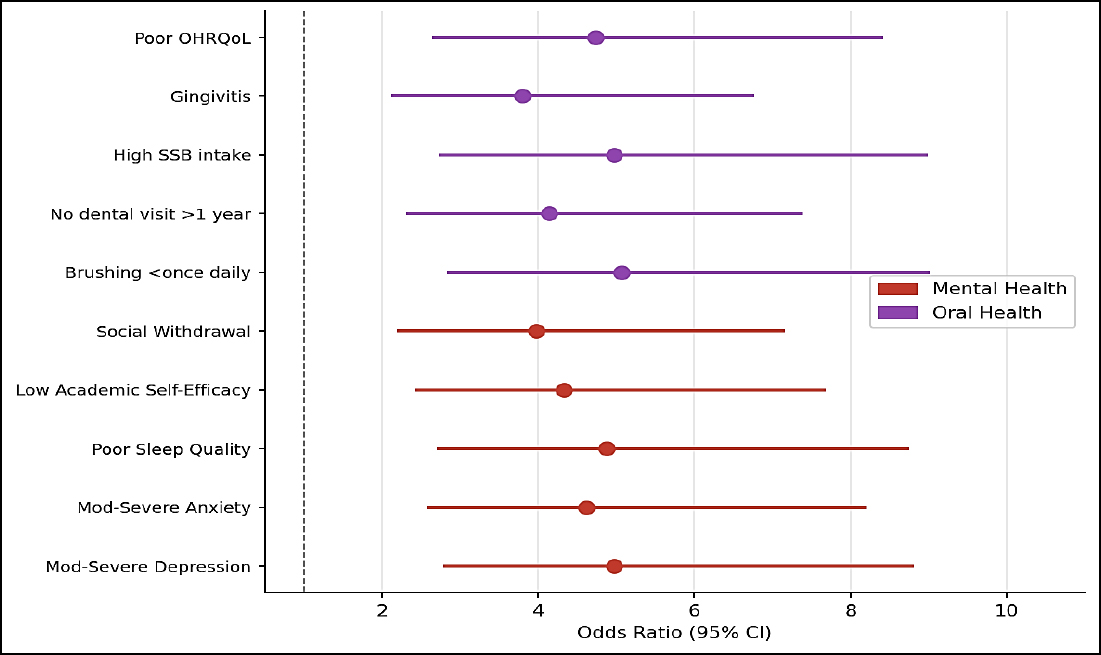
Forest-style plot displaying point estimates and 95% confidence intervals for mental health (red) and oral health (purple) outcomes. Dashed vertical line marks OR=1 (null effect) is shown in Figure 1.
This cross-sectional research is one of the first to report a significant triadic relationship between problematic gaming behavior, mental health impairment, and oral health deterioration among BDS undergraduates in an urban Indian setting. The prevalence of PGB was found to be 30.7% with a significant male dominance, which is in line with and contextualises with the results of several recent PubMed-indexed studies.
The research by Chavan et al (2024) [17] is a cross-sectional study of 385 dental students in Belagavi, India, which reports that IGD was strongly associated with physical symptoms, such as musculoskeletal pain and sleep disturbance, and that male students showed greater engagement in gaming. Our research confirms this male preponderance, and extends this to record the important mental health and oral health effects of the same population.
Chandra et al. (2022) [18] determine the prevalence of problematic online gaming and mental well-being among professional college students in Rishikesh, India, finding a prevalence of problematic online gaming of 27.4% and significant association with poor mental well-being and depressive symptoms using the WHO-5 and PHQ-9. The prevalence of 30.7% in our study is in line with this estimate, and the strong association between PGB and moderate-to-severe depression (OR=4.97) in our cohort reflects their findings, which further supports the mental health burden of gaming in Indian populations of professional students.
Interestingly, Idris et al. (2023) [19] studied IGD, depression, and anxiety in university students during the COVID-19 pandemic, and found that IGD was significantly related to depression and anxiety on the DASS-21. The results obtained with the PHQ-9 and GAD-7 are concordant with more than half of PGB-positive students having reached the threshold of moderate-to-severe anxiety.
Ghareghol et al. (2022) [20] examined the relationship between problematic internet use and oral health-related quality of life among Iranian medical and dental students, and found the significant negative effect on OHRQoL scores. These findings are extrapolated by our data to specifically PGB, with 65.2% of PGB-positive BDS students showing poor OHIP-14 scores as compared to 27.9% of non-PGB counterparts, confirming that gaming-related digital dependency worsens oral health-related quality of life in dental student cohorts.
A nationally representative US adult sample showed a significant relationship between depression and untreated dental caries coronal caries in a nationally representative sample of adults in the United States [21]. Our investigation records a parallel connection in a more youthful group of dentistry students, with depression being linked to DMFT scores almost twice as high as non-PGB counterparts, together with significantly compromised brushing frequency and dental visit avoidance, and substantiating depression as a key mediating pathway between gaming behavior and caries burden.
According to Isralowitz et al. (2022) [22], gaming disorder in university students was linked to increased intake of foods high in sugar and salt and poor economic wellbeing. The finding that the proportion of PGB-positive students who consumed high amounts of sugar-sweetened beverage was high (73.9%), as compared to that of 36.1% of the controls, a finding that is directly concordant with this pattern of dietary behavior. Combined, the current findings provide a strong evidence base to include the digital addition screening and oral health promotion in the BDS student wellness programmes.
The limitations of this study are that it is cross-sectional and is not able to provide causal conclusions between problematic gaming behavior, mental health issues and oral health outcomes. Also, the study was done in one city environment, which limits the applicability of the results to other areas or populations. The fact that self-reported data on the gaming habits, the mental and oral health practices were used introduces the possibility of recall bias, and the convenience sampling technique used by a single dental college may provide a sample that is less diverse, which further limits the applicability of the study.
Problematic gaming behavior is common among BDS undergraduate students in urban environments and is significantly linked to impaired mental health, poor oral hygiene practices, high experience of caries and low oral health-related quality of life. The male gender, nocturnal gaming habits, and the use of gaming as emotional coping strategy become the significant risk factors which should be screened specifically in dental institutions. The introduction of validated digital screening tools of addiction, as well as oral health promotion and mental health counselling into the undergraduate dental curriculum is an evidence-based and much-needed institutional priority.
