Oral Sphere
Journal of Dental and Health Sciences

Journal of Dental and Health Sciences
Received: 2026-03-24
Accepted: 2026-05-23
Published: 2026-07-01
Pages: 181-186
Background: Generalized dental attrition is a prevalent clinical condition commonly associated with parafunctional habits such as bruxism and clenching. It can result in loss of vertical dimension, dentin exposure, hypersensitivity, compromised esthetics, and functional impairment. Early conservative intervention is essential to prevent further structural deterioration. Occlusal splints, particularly night guards, are widely used reversible prosthodontic appliances for managing such conditions.
Case Presentation: This case report describes the conservative management of generalized attrition in a 65-year-old female patient using a soft night guard (soft occlusal splint). A comprehensive diagnostic and occlusal evaluation were performed prior to treatment planning. The appliance was fabricated using a vacuum-formed thermoplastic sheet to ensure optimal adaptation and patient comfort. The soft occlusal splint acted as a protective interface between opposing dentition, reducing the impact of nocturnal parafunctional activity and preventing further tooth wear. The patient was provided with detailed usage and maintenance instructions. Clinical outcomes and patient adaptation were evaluated over a follow-up period of three months through periodic assessments.
Conclusion: The use of a soft night guard represents a simple, non-invasive, and cost-effective approach for managing generalized attrition associated with parafunctional habits. The present case demonstrated improved patient comfort and stabilization of occlusal wear, highlighting the effectiveness of this conservative prosthodontic intervention.
Tooth wear is defined as the gradual loss of dental hard tissues resulting from mechanical and chemical processes that do not involve bacterial activity [1]. Attrition specifically denotes the loss of tooth structure caused by tooth-to-tooth contact during normal functional movements or parafunctional activities such as bruxism and clenching [2].
Generalized attrition can have a considerable impact on occlusal stability, vertical dimension, and overall oral function. Clinically, patients may present with flattened occlusal surfaces, exposed dentin, hypersensitivity, and decreased masticatory efficiency [3]. In advanced cases, it may contribute to temporomandibular disorders (TMD), pulpal complications, and esthetic concerns [4].
Bruxism is considered one of the primary etiological factors associated with generalized attrition. It is defined as repetitive jaw muscle activity characterized by clenching or grinding of the teeth and/or bracing or thrusting of the mandible. The reported prevalence of bruxism in the adult population ranges from approximately 8% to 31% [5].
Several treatment approaches have been suggested for the management of tooth wear, ranging from preventive and interceptive measures to comprehensive prosthodontic rehabilitation [6]. Occlusal splints or night guards represent a conservative and reversible treatment modality that helps protect teeth from further wear and minimizes the harmful effects of parafunctional habits [7],[8]. These appliances function by redistributing occlusal forces, promoting neuromuscular relaxation, and serving as a protective barrier between opposing teeth [9].
Therefore, this case report is important to assess the effectiveness of a soft night guard as a conservative management strategy in controlling generalized attrition and preventing further occlusal deterioration associated with parafunctional habits.
A 65-year-old female patient reported to a private dental clinic in Chandigarh, India, with the chief complaint of sensitivity in multiple teeth and progressive flattening of the tooth surfaces over the past three years.
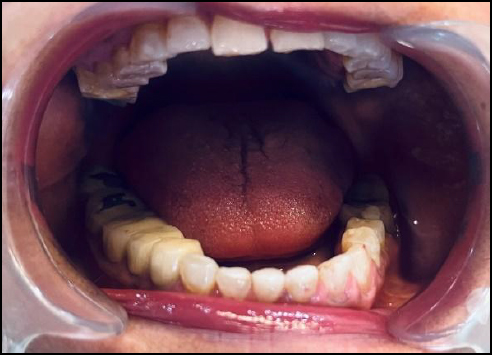
On clinical examination, extraoral assessment revealed no significant facial asymmetry or abnormalities of the temporomandibular joint. Intraoral examination demonstrated generalized attrition involving both maxillary and mandibular posterior teeth Figure 1.
The occlusal surfaces appeared flattened with areas of dentin exposure, and mild hypersensitivity was noted in the posterior teeth. Despite the extent of wear, there was no significant loss of vertical dimension of occlusion. Clinical findings also suggested the presence of nocturnal bruxism. The patient reported a history of grinding her teeth during sleep, which was confirmed by family members. Radiographic examination using an orthopantomogram revealed normal periapical structures with no evidence of pulpal pathology.
Based on the clinical findings and patient history, the condition was diagnosed as generalized attrition associated with nocturnal bruxism. Considering the moderate severity of tooth wear and the absence of significant loss of vertical dimension, a conservative prosthodontic treatment approach was planned. The treatment plan included fabrication of a soft night guard (soft occlusal splint), patient education along with behavioral modification, and periodic follow-up with occlusal evaluation.
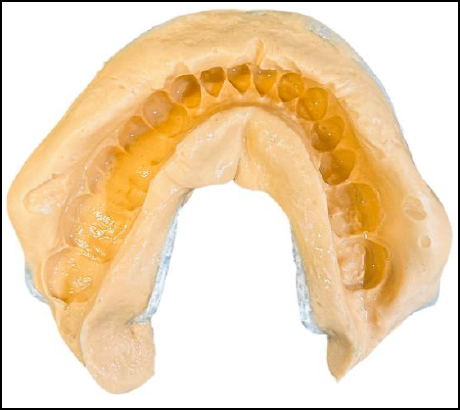
For the clinical procedure, primary impressions of the maxillary and mandibular arches were made using irreversible hydrocolloid (Zelgan 2002, Dentsply India Pvt. Ltd., Haryana, India) Figure 2.
The impressions were poured using type III gypsum dental stone (GypRock stone, Rajkot, Gujarat, India) to obtain diagnostic casts Figure 3. The casts were subsequently mounted on a semi-adjustable articulator (Hanau™ Wide-Vue, Whip Mix, Kentucky, USA) using an interocclusal record to evaluate occlusal contacts and the pattern of tooth wear.
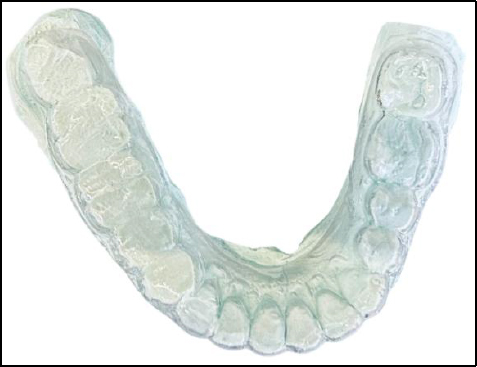
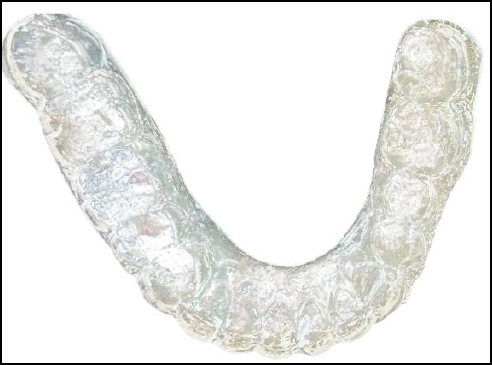
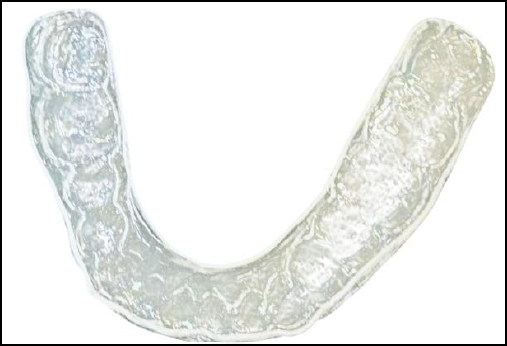
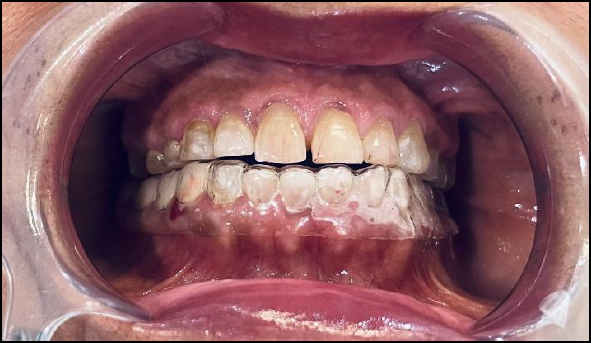
A soft night guard was fabricated using a 2–3 mm thermoplastic soft splint sheet that was vacuum-formed on the maxillary cast. Following fabrication, the appliance was carefully trimmed, finished, and polished to eliminate sharp edges and ensure patient comfort Figure 4 and Figure 5. The completed appliance was then inserted intraorally Figure 6 and evaluated for proper fit, occlusal contacts, and overall patient comfort. Minor occlusal adjustments were performed to achieve even contact with the opposing dentition.
Detailed instructions regarding the use, hygiene, and maintenance of the night guard were provided to the patient. The patient was advised to return for follow-up visits after one week, one month, and three months.
During the subsequent follow-up visits, the patient reported a noticeable reduction in tooth sensitivity and improved comfort during sleep. Clinical evaluation also indicated that there was no further progression of tooth wear. The appliance remained well-adapted and functionally effective throughout the follow-up period.
The patient reported a high level of comfort while using the soft night guard and expressed satisfaction with the treatment outcome. She noted a significant reduction in tooth sensitivity and improvement in sleep quality within a few weeks of use. The appliance was easy to insert, remove, and maintain, which contributed to consistent compliance. Overall, the patient perceived the treatment as convenient, non-invasive, and effective in managing her condition.
Table 1 summarizes the post-delivery instructions provided to the patient regarding insertion and removal, cleaning protocol, storage conditions, usage recommendations, and precautions required to maintain appliance hygiene, durability, and optimal therapeutic outcomes.
| Instruction Category | Recommendation |
|---|---|
| Insertion and Removal | Insert the night guard gently over the teeth using light finger pressure. Avoid forcing the appliance into position. Remove it carefully using both hands to prevent distortion. |
| Usage Duration | Wear the night guard every night during sleep or as directed by the dental surgeon to ensure continuous protection against bruxism-related tooth wear. |
| Cleaning Protocol | Clean the appliance after each use with a soft toothbrush and mild soap or non-abrasive toothpaste. Rinse thoroughly with cool or lukewarm water. Avoid abrasive cleaners or harsh chemicals. |
| Water Temperature | Do not use hot or boiling water for cleaning, as high temperatures may distort the thermoplastic material and affect the fit of the appliance. |
| Storage Conditions | Store the night guard in a ventilated protective container when not in use to maintain hygiene and prevent damage. Keep the container clean and dry. |
| Dietary Precautions | Do not chew on the appliance or wear it while eating, as this may damage or deform the splint. |
| Damage or Discomfort | If the appliance becomes loose, fractured, uncomfortable, or distorted, consult the dental surgeon immediately for evaluation and possible adjustment or replacement. |
| Follow-Up Visits | Attend regular dental check-ups to assess the condition of the night guard and monitor the progression of tooth wear or bruxism. |
Tooth wear is a multifactorial condition that may result from attrition, abrasion, erosion, or a combination of these processes [10]. Among these factors, attrition is commonly associated with parafunctional activities such as bruxism [11]. Bruxism can generate occlusal forces that are considerably greater than those produced during normal mastication, leading to accelerated wear of dental structures [12]. Persistent bruxism may also contribute to muscle fatigue, discomfort in the temporomandibular joint, and headaches [13]. Occlusal splints are widely recommended as both preventive and therapeutic appliances for the management of bruxism and tooth wear. Singh BP et al. (2017) [14] described occlusal splints as removable appliances designed to establish harmonious contact relationships between the maxillary and mandibular teeth.
Soft night guards are typically fabricated from thermoplastic elastomeric materials and are often preferred for patients with mild to moderate bruxism because of their flexibility and improved comfort. These appliances function as a protective cushion that helps distribute occlusal forces and reduce the intensity of direct tooth-to-tooth contact [15].
C Popovici (2025) [16] reported that occlusal splints help decrease abnormal muscle activity and protect dental structures from excessive wear. Similarly, Harada et al. (2006) [17] demonstrated that the use of night guards can significantly reduce both the frequency and intensity of bruxism episodes.
Patient compliance is a critical factor in the effectiveness of occlusal splint therapy. Therefore, clear instructions Table 1 regarding appliance insertion, cleaning, and storage are essential to maintain adequate hygiene and extend the longevity of the appliance [18].
A critical consideration in occlusal splint therapy is the choice between soft and hard occlusal splints. Soft splints are fabricated from resilient thermoplastic materials and are generally preferred in patients with mild to moderate bruxism due to their superior comfort, ease of fabrication, and better patient compliance. They act as a shock-absorbing interface, reducing occlusal load transmission and minimizing tooth wear.
In contrast, hard occlusal splints, typically made from acrylic resin, provide more precise occlusal control and are often indicated in patients with severe bruxism or temporomandibular disorders. Hard splints facilitate occlusal equilibration, improve mandibular positioning, and may reduce muscle hyperactivity more effectively. However, they require meticulous adjustment, are technique-sensitive, and may initially be less comfortable for patients, potentially affecting compliance.
Therefore, the selection between soft and hard splints should be individualized based on the severity of parafunctional activity, patient comfort, compliance, and overall treatment objectives.
The primary limitation of this case report is the short follow-up duration of three months, which may not adequately reflect long-term outcomes of occlusal splint therapy. Additionally, as a single case report, the findings cannot be generalized to a broader population. Future studies involving larger sample sizes and extended follow-up periods are recommended.
The conservative management of generalized attrition using a soft night guard offers a simple, non-invasive, and cost-effective therapeutic approach. The present case demonstrated favorable clinical outcomes, including reduction in hypersensitivity and stabilization of tooth wear. However, this report represents a single clinical case with a limited follow-up duration of three months, which restricts the generalizability of the findings. Long-term randomized controlled trials and larger case series are necessary to validate the efficacy and durability of soft occlusal splints in managing bruxism-associated attrition.
