
Oral Sphere
Journal of Dental and Health Sciences
Journal of Dental and Health Sciences
Received: 2026-02-23
Accepted: 2026-05-22
Published: 2026-07-01
Pages: 187-192
Background: Fractures affecting the mandible and particularly comminuted types are common outcomes of road traffic accidents (RTAs) and they may trigger severe functional and aesthetic impairment. Such injuries are incurable without optimum management that will restore form and functionality of the mandible. The reconstruction plate used in open reduction and internal fixation (ORIF) has become the gold standard of complex mandibular fractures because of its ability to assure a stable fixation and allow the optimality of osseous healing. The case report explains how ORIF using a reconstruction plate was used in the treatment of a comminuted mandibular fracture and reports a positive result of the intervention.
Case Presentation: A 32-year-old man was brought to a trauma centre with an RTA. He presented with significant levels of pain, swelling and trismus and the tenderness was localized to the mandible. Radiographic examination- plain radiograph and computed tomography showed a comminuted fracture in the mandible which was made of several fragments. After the thorough pre-operative assessment, the patient was subjected to ORIF with a reconstruction plate. The surgery was performed without complications during the surgery, and a stable fixation was obtained. The patient followed a soft diet and prescription of antibiotics and analgesics post-operatively. Follow-up test showed significant functional improvement, no malocclusion or infection, and radiographs of proper alignment and fracture healing.
Conclusion: The presented case supports the effectiveness and the dependability of ORIF using a reconstruction plate to treat comminuted fractures of the mandible as a result of traumatic injury. Reconstruction plates provide a fixation that is stable and thus the early rehabilitation process is hastened leading to a decrease in the number of complications. Immediate treatment, careful surgery, and attentive postsurgical care are crucial towards ideal functional and aesthetic outcomes. The results support the use of ORIF in preference with reconstruction plates in the treatment of complex fractures of the mandible.
Fractures of the mandible form a considerable percentage of the number of face injuries that are seen in trauma patients, where road traffic accidents (RTAs) form the leading etiologic agent [1]. The mandible being the main bone constituent of the mandible is considerably vulnerable to fractures especially in the body and angular areas. The injuries normally occur in the form of simple or comminuted fractures, the latter being more complicated because of the existence of several fragments of the fracture, which is a result of the traumatic shock [2]. Comminuted fractures of the mandible are a specific issue both in the diagnostic and in the treatment area, requiring attention to the surgical procedure, which includes restoring the morphology, physiological ability and aesthetics [3].
A comminuted mandibular fracture is a fracture in which the bone is broken into three or more separate parts. Besides the bony disruption, such fractures can be accompanied by substantial soft tissue injury, occlusal misalignment, or airway obstruction, which increases the probability of postoperative complications [4]. As a result, these fractures require a personalized treatment plan that takes into account the evaluation of the severity of the fracture, general health condition of a patient, and risk of complications. Effective analgesia, infection prophylaxis, functional restoration and cosmetic rehabilitation are the objectives of treatment [5].
The ORIF has been considered the standard-of-care when treating complex fractures of the Mandible, especially comminuted ones, because direct visualization allows the fracture pieces to be anatomically reduced [6]. The use of reconplates as internal fixation has become more popular due to the strength, flexibility, and ability to maintain long-term positioning of fractured fragments. Reconplates are also designed to recreate mandibular continuity and facilitated the healing of bones with the least needed soft tissue dissection [7]. The main benefit of the use of reconplate is that it offers stable fixation, which allows the achievement of the early mobilization and improvement of functional outcomes [8].
The type of surgery to be used on mandibular fractures depends on the location, complexity, and the presence of injuries. Intraoral method is mostly used because of its low scarring and increased accessibility to the fracture area [9]. Nevertheless, an extra-oral method can be justified in cases of severe soft tissue injury or fractures of anatomically unfavorable position. In both cases, proper anatomic reduction and fixation is crucial to ensure proper healing and to regain the occlusion and functional status of the patient [10].
Immediate follow-ups and close follow-ups are critical to the success of the therapy. These patients are normally prescribed a course of antibiotics to avoid infectious complications and analgesics to deal with the postoperative pain [11]. Soft diet is recommended in some situations and the patient may be advised not to take excessive mandibular excursions within several weeks so that they can have enough time to consolidate the fractures.
The follow-up consultations are essential in assessing bone healing, complications development, including infection or malocclusion that the treatment plan may need adjustment [12].
The present case report discusses the treatment of a 32-year-old male patient who presents with a comminuted fracture of the mandible as a result of an RTA. The patient received ORIF using a reconplate fixation technique that was able to restore the mandibular structure and deliver a positive functional and aesthetic result. The case highlights the significance of early and effective treatment of mandibular fractures and proves the effectiveness of modern surgical practices in supporting the most successful patient recovery.
The case is about a 32 years old male patient who was admitted to the emergency department after a high-speed road traffic accident.
The victim was driving and at the time of the road accident he was not fastened with a seatbelt. He came to the hospital through emergency services and was in a conscious state but has complained of severe pain. The findings showed facial trauma, and the significant edema and ecchymosis were localized to the mandible.
The patient complained about intense pain and swelling of the mandible, short aperture of the mouth, poor mastication and speech. Tenderness was palpable over the mandible particularly with palpation. No loss of consciousness, no hemorrhage or obstruction of the airways. The patient has no previous experience of facial trauma or preexisting mandibular pathology.
General Examination: The patient was oriented and alert with a hemodynamic stable vital sign assessment, blood pressure, 120/80mmHg, heart rate 88bpm, respiratory rate 18/min and temperature 98.6 F. No acute life-threatening injuries and respiratory distress.
Facial Examination: There was pronounced edema and ecchymosis of the left and right mandibular body parts with a deformity of the lower jaw being discerned, to indicate that there was a displaced fracture. A palpation provided palpation of the fractured mandibular zone and palpation produced crepitus, which is a sign of a bony injury. The patient complained of the inability to open her mouth and also displayed a limited degree of mandibular movement.
Intra-Oral Examination: The mouth opened normally, but the periodontal tenderness in the mandibular molar regions was present. No active bleeding or cuts were detected in the mouth, but a small malocclusion was observed, which is due to the malalignment of the fractured parts.
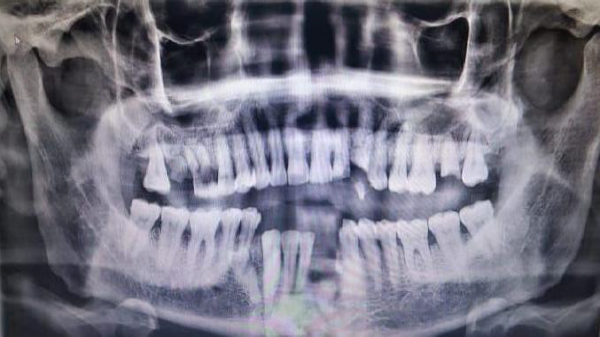
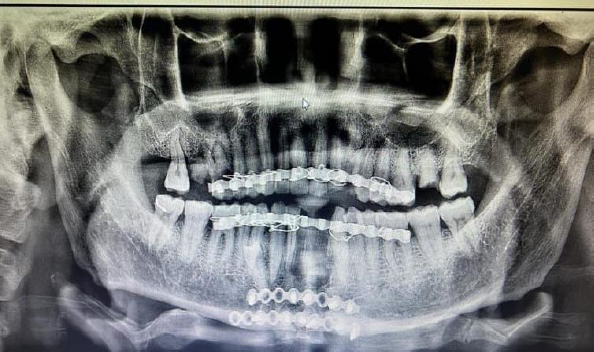
Diagnostic Imaging: A panoramic X-ray revealed a comminuted fracture of the mandibular body, with multiple bone fragments and displacement of the fractured segments. The fracture was located bilaterally in the body of the mandible, extending near the molar regions. No other facial bone fractures were observed Figure 1.
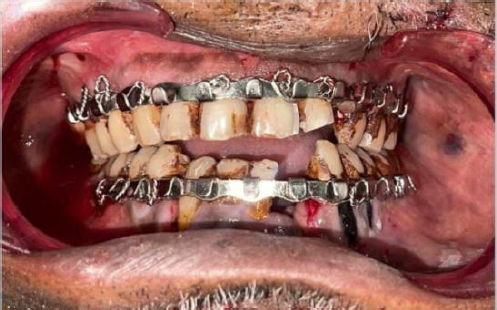
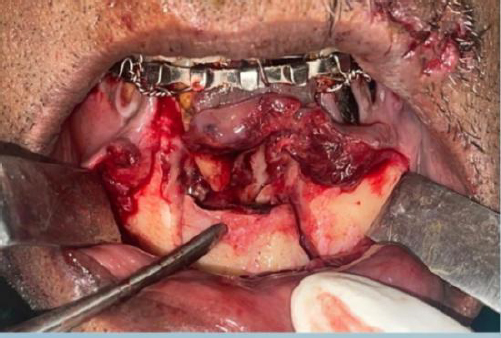
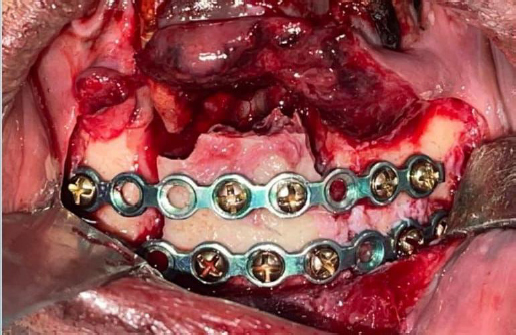
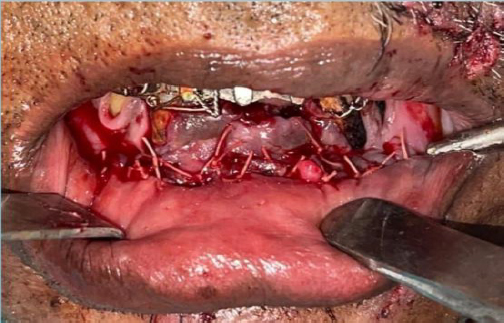
Figure 2 presents an intraoral view of the fractured region, where orthodontic wire has been used for initial stabilization. Figure 3 illustrates the surgical approach, depicting the exposure of the fracture site and the preparation for open reduction. Figure 4 captures the placement of the reconplate for the internal fixation of the fractured bone fragments. Figure 5 displays the final positioning of the reconplate and screws, ensuring proper alignment and stabilization. Finally, Figure 6 shows the postoperative panoramic X-ray, confirming the successful alignment and fixation of the mandible after the ORIF procedure.
Treatment of comminuted mandibular fractures has remained as one of the complicated dilemmas in maxillofacial trauma therapy since it involves numerous fragments of the bone and fixation of the fragments by stable mechanisms in order to ensure optimal recovery and functional results. In the given case, the comminuted fracture of the mandibulas caused by a road traffic accident was effectively treated with the help of open reduction and internal fixation (ORIF) plate composed of reconstruction plate (reconplate) in accordance with the existing literature on best practice.
Traditionally, the management of mandibular fractures involved the use of the closed reduction technique followed by maxillomandibular fixation (MMF) that was meant to protect the integrity of the vascularity and avoid excessive disturbance of nearby soft tissues. Launched more recently though, is the very common practice of open reduction and internal fixation (ORIF) using rigid internal fixation especially in the case of displaced and comminuted fractures, especially its ability to provide direct anatomical realignment and rapid functional recovery. The broad overview of comminuted mandibular fracture treatment proves that ORIF utilizing plates and screws provides a secure internal fixation and has the benefit of providing more accurate bone fragment positioning compared to closed management methods. Such an augmented stability simultaneously shortens the course of MMF and advances an earlier restoration of functioning, hence justifying the tact used in the current scenario [13].
The use of reconstruction plates in the treatment of comminuted mandibular fractures is supported by prospective clinical evidence. An evaluation of a low-profile locking mandibular reconstruction plate in a group of twelve patients has shown that open-in-fracture fixation (ORIF) in the presence of a low-profile locking plate provides a reliable fixation, early functional recovery, as well as satisfactory bone healing without any significant complications in a mean follow-up period of over one year. Such results are in line with our case results, whereby stable fixation and positive clinical outcome were noticed as well [14].
The existing literature is abundant in series of cases and case reports that substantiate the idea that open reduction and internal fixation (ORIF) with reconstruction plating provide better results in comminuted mandibular injuries.
A documented case of widely comminuted mandibular fracture with a combination of locking reconstruction plated and miniplates only provided satisfactory consequences on restoration of anatomical direction thus validating the effectiveness of reconstruction plated in stabilizing complex mandibular fractures [15].
A systematic review by Barry RG et al. (2018) [16] of the literature in the comparison of ORIF and other methods shows that surgical management is more of a tendency among elderly people. The retrospective studies of the outcomes after ORIF indicate that this surgical method has positive outcomes, including decreased malocclusion and improved functional outcome; more so, imaging guidance, especially CT scanning, can be used to supplement preoperative planning in such complicated fractures.
Despite the examination of smaller fixation systems including miniplates in conjunction with particular fracture configurations, the available literature is that in fractures of high community, where the load bearing ability is of the highest importance and mechanical stability is of the foremost importance, larger reconstruction plates can be of better benefit to segments of fractures [17]. This fact corresponds to the choice of a reconstruction plate in the current case.
Alongside the choice of surgical method, postoperative treatment and its early follow-up are the primary factors in preventing complications like infection, malunion, and nonunion. An adherence to the existing protocols such as antibiotic prophylaxis, dietary prudence and periodical imaging monitoring have been reported to enhance positive outcome in healing processes [4], a point that is also supported in the present case.
Open reduction and internal fixation (ORIF) of comminuted mandibular fractures with reconstruction plates have proved to be very effective as seen in the current case. This method can provide consistent skeletal fixation, promote early bone healing, and diminish the incidence of complications, which is supported by the results of earlier researchers that indicate its superiority in comparison to other therapeutic interventions. The postoperative course of the patient provides the importance of effective preoperative planning, timely surgical intervention, and further postoperative care in the realisation of positive results in the treatment of mandibular fracture.
The feelings right after the accident were characterized by a sense of panic and uncertainty since I realized that there was a lot of damage to my mandible. The pain was intense and the swelling of the area around my face made it hard to talk and chew. At first, I was not able to realize the severity of the injury, but after the medical staff provided a detailed examination and radiographic images of the case, I was provided with the information that my mandible had suffered a comminuted fracture consisting of several bone pieces.
During a time when the medical team suggested open reduction and internal fixation (ORIF) and reconstruction plate, a twofold response of relief and anxiety occurred. Although I understood that the ideal methodology to restore the mandibular functionality was ORIF and the reconstruction plate, I was still scared of the surgery process and the rehabilitative process thereupon.
The surgeon outlined the ORIF guideline, outlined how it was going to be executed, the use of the reconstruction plate, and how it would be used to re-align bone fragments to maintain mandibular stability in the healing process. Even though I believed in the experts of the medical team, I felt a certain level of anxiety when it came to surgery.
The surgery went on smoothly, and I was relieved to a significant degree when it was over. I spent some time in the post-operational ward. The first few days of the operation were difficult because of the pain and edema; however, the staff was vigilant with regard to pain management and comforting of patients. Antibiotics were administered in order to reduce the risk of infection and I was asked to follow up on a soft diet in the first year of recovery, which I did faithfully. The limited range of opening the mouth and mouth milling made even the simple activities like eating and talking a burden but the clinicians assured me that these were just parts of the recovery process and that I would improve with the healing of the bone.
In the post-operative period, I found the systematic follow-ups and examinations to be a great experience because the medical team would give me new radiographs to track my healing process. The postoperative images were useful in giving confidence that the plate and bone fragments put in place during the reconstruction were put in place properly and the process of bone recovery was going on as expected. At one-month follow-up, I noticed that there were major improvements in mouth opening and speech, and the pain had significantly subsided, which allowed increasing the diet slowly, introducing solid food.
Reflectively, I owe much of my debt to the intervention and care provided by the medical team. The ORIF reconstruction plate fixation achieved its desired purpose, both in providing mechanical stability, but also in providing a faster recovery trajectory than I had imagined. This was a postoperative outcome that allowed the reestablishment of the mandibular functionality and limited the probability of long-term consequences, e.g., malocclusion or misalignment. Through this experience, it has been highlighted how timely clinical intervention is and how effective skilled surgical care is in restoring normal functioning and quality of life after traumatic injuries.
