Oral Sphere
Journal of Dental and Health Sciences

Journal of Dental and Health Sciences
Received: 2026-05-12
Accepted: 2026-08-18
Published: 2026-10-01
DOI: https://doi.org/10.63150/osjdhs.2026.34
Pages: 230-236
Background: Periodontal disease is prevalent among young adults, including dental students. Appropriate oral hygiene practices are essential for maintaining gingival health; however, dental students may not always follow optimal oral hygiene behaviors. This study evaluated the association between oral hygiene practices and gingival health among dental university students in Pakistan.
Methods: A cross-sectional study was conducted among 150 dental university students in Pakistan using a structured online questionnaire. Data regarding demographic characteristics, oral hygiene practices, and self-reported gingival health were collected. Associations between oral hygiene practices and gingival health were assessed using the Chi-square test. Binary logistic regression was performed to identify independent factors associated with poor gingival health after adjustment for relevant demographic variables.
Results: Among 150 participants, 90 (60.0%) reported brushing twice daily and 117 (78.0%) reported using fluoride toothpaste. Swollen or red gums were reported by 77 (51.3%) participants, while 20 (13.3%) reported gingival bleeding sometimes or frequently. Toothbrushing frequency (χ2 = 13.64, p = 0.003) and brushing duration (χ2 = 17.45, p < 0.001) were significantly associated with gingival health. Brushing at least twice daily (AOR = 0.17, 95% CI: 0.07–0.42, p < 0.001) and brushing for at least two minutes (AOR = 0.13, 95% CI: 0.05–0.36, p < 0.001) were independently associated with lower odds of poor gingival health. Interdental cleaning, mouthwash use, tongue cleaning, fluoride toothpaste use, and routine dental visits were not significantly associated with poor gingival health.
Conclusion: Higher toothbrushing frequency and longer brushing duration were independently associated with better self-reported gingival health among dental university students in Pakistan. Reinforcing appropriate toothbrushing practices during undergraduate dental education may support better oral health behaviors and periodontal health.
Oral health is an integral part of general health and well-being and is viewed as a key component in human health [1]. It involves the capacity to undertake the basic functions of the oral cavity (feeding, speaking, smiling, emotional expression) without discomfort, pain or disease in the craniofacial area [2],[8]. Oral health education plays a crucial role in health promotion but still remains a significant public health problem in the world [3]. Oral diseases, such as dental caries and periodontal diseases, are among the most common diseases and are a significant contributor to tooth loss, especially in developing countries [4]. Reversely, the prevalence of caries has decreased in certain groups, but it remains a significant public health problem. There are several indices that can be used to assess oral health status, such as the decayed, missing, and filled teeth (DMFT) index [6]. There are various contributing factors to the occurrence and progression of oral diseases, such as: microbial pathogens, dietary and nutritional factors, socioeconomic conditions, lifestyle, environmental factors and exposure to fluoride [7]. The FDI World Dental Federation has defined oral health as the ability to speak, smile, smell, taste, touch, chew, swallow and express a variety of emotions with confidence and without discomfort, pain or disease affecting the craniofacial region in 2016 [8].
Oral health is closely related to overall health, and oral diseases have been linked to a variety of systemic diseases, such as diabetes, cardiovascular diseases, metabolic disorders, adverse pregnancy outcomes and obesity [9]. On the other hand, oral diseases can lead to systemic inflammatory response and can be relevant to health [10]. Although oral health is also a major component of health care, it is often neglected in the context of overall health care priorities, and oral disease is among the most prevalent health conditions in the world [11]. Caries and periodontitis are among the two most significant oral diseases worldwide and one of them involves a major proportion of the population [12].
Preventive practices and effective oral health promotion are essential to maintaining good oral health, and must include both dental and medical professionals. Understanding of preventive oral health care can help shape the attitudes and behaviors of oral health care providers, which can then impact the oral health counsel and care they offer to their patients [14]. Dental and medical students, thus, are an important group to target when it comes to awareness of good oral health and teaching of proper preventive behaviors. Their learning, attitudes and personal oral health care habits could affect their role in the delivery of oral health promotion services to patients and the community as future health-care professionals [15],[16].
Dental students are given formal training and education in oral health and are expected to engage in the appropriate behavior for preventing oral health issues. But, the knowledge of profession does not guarantee the constant practice of recommended oral hygiene. Other factors such as individual, cultural, environmental and social factors may also influence oral hygiene behaviors. Thus, the oral hygiene habits of dental students and their association with gingival status is significant to determine the discrepancy between knowledge about oral health and individuals' preventive care. The current study was conducted to evaluate the correlation between oral hygiene and gingival condition in dental university students, in Pakistan.
A descriptive cross-sectional study was conducted among dental university students in Pakistan to assess the association between oral hygiene practices and self-reported gingival health. Data were collected at a single point in time using a structured online questionnaire.
A total of 150 dental university students from public and private dental institutions participated in the study. Participants were recruited using a non-probability convenience sampling approach. Students who were enrolled in a dental university and provided electronic informed consent were eligible to participate. Students who did not provide informed consent, submitted incomplete responses, or submitted duplicate responses were excluded.
The sampling technique employed was non-probability sample, convenience sampling technique. The questionnaire was sent to the dental students who were easy to access online from various universities, and the ones who fulfilled the eligibility criteria and responded to the survey willingly were included.
A structured online questionnaire was developed according to the objectives of the study. The questionnaire consisted of two sections. The first section collected demographic information, including age, sex, year of study, and type of university. The second section assessed oral hygiene practices and self-reported gingival health.
Oral hygiene variables included toothbrushing frequency, brushing duration, fluoride toothpaste use, interdental cleaning, mouthwash use, and tongue cleaning. Gingival health was assessed using questions regarding gingival bleeding, swollen or red gums, and participants' overall perception of their gingival health.
The questionnaire was administered through an online Google Form and distributed through social media groups and academic forums associated with participating dental institutions. Participation was voluntary, and electronic informed consent was obtained before questionnaire completion. Participants were instructed to submit the questionnaire only once, and responses were checked for completeness before analysis.
In the demographic section, age, sex, year of study, type of university and university/institution were provided. The second section contained 10 questions related to selected oral hygiene behaviors and indicators of the health of the gums, how often and long participants brush their teeth, use fluoride toothpaste, clean between teeth, use mouthwash, clean the tongue, bleed gums, red swollen gums, visits the dentist, and their perceived gingival health.
The questionnaire was translated to an online Google Form and sent out via social media groups and academic forums of the participating dental universities. The study purpose, voluntary participation, and assurance of confidentiality were included in an introductory statement at the top of the form. All the participants who accepted the participation completed the questionnaire after giving electronic informed consent. All participants were asked to fill out the questionnaire only once. Responses were gathered electronically and completeness checked prior to analysis.
They comprised those attending a dental university, members of the targeted population who volunteered to participate in the study, those participants who had signed a inquiry about their electronic informed consent and those who responded to the online questionnaire. The participants who failed to be enrolled in a dental university, who didn't give informed consent, who gave incomplete answers, or who gave duplicate answers were excluded.
Data were coded and analyzed using IBM SPSS Statistics version 26. Categorical variables were summarized using frequencies and percentages. Associations between oral hygiene practices and gingival health indicators were assessed using the Chi-square test of independence. Fisher's exact test was used when the expected cell frequency was less than five. Statistical significance was set at p < 0.05.
For multivariable analysis, gingival health was dichotomized into good and poor categories. Good gingival health was defined based on excellent/good self-rated gingival health, absence or rare occurrence of gingival bleeding, and absence of swollen gums. Poor gingival health was defined by fair/poor self-rated gingival health and/or the presence of sometimes/frequent gingival bleeding or swollen gums. Binary logistic regression was performed to determine the independent association between oral hygiene practices and poor gingival health. Adjusted odds ratios (AORs) with 95% confidence intervals (CIs) were reported.
150 dental university students were involved in the study. The largest proportion belonged to the 21–23-year age group (63, 42.0%), followed by 18–20 years (45, 30.0%), 24–26 years (30, 20.0%), and ≥27 years (12, 8.0%). Of the participants, 93 (62.0%) were female and 57 (38.0%) were male. The participants were evenly distributed according to the five academic years with 30 students (20.0%) from each year. As for the type of the university, 82 (54.7%) respondents came from private universities and 68 (45.3%) respondents from public universities Table 1.
| Variable | Category | n | % |
|---|---|---|---|
| Age | 18–20 years | 45 | 30.0 |
| 21–23 years | 63 | 42.0 | |
| 24–26 years | 30 | 20.0 | |
| ≥27 years | 12 | 8.0 | |
| Gender | Male | 57 | 38.0 |
| Female | 93 | 62.0 | |
| Year of Study | 1st Year | 30 | 20.0 |
| 2nd Year | 30 | 20.0 | |
| 3rd Year | 30 | 20.0 | |
| 4th Year | 30 | 20.0 | |
| 5th Year | 30 | 20.0 | |
| University Type | Public | 68 | 45.3 |
| Private | 82 | 54.7 |
Concerning oral hygiene practice, 90 (60.0%) of them brushed their teeth twice daily, 16 (10.7%) more than twice daily, 33 (22.0%) once daily and 11 (7.3%) less than once daily. 63 (42.0%) participants reported brushing for 1-2 minutes and 60 (40.0%) for 2-3 minutes. 117 (78.0%) participants used fluoride containing toothpaste. 23 (15.3%) participants reported using interdental cleaning methods every day, while 45 (30.0%) reported that they never used interdental cleaning methods. Likewise, 23 (15.3%) participants stated using mouthwash daily and 72 (48.0%) cleaned their tongue daily Table 2.
In terms of gingival health, 80 (53.3%) stated that there was no bleeding from their gums, 50 (33.3%) indicated that gums rarely bleed, 16 (10.7%) sometimes, and 4 (2.7%) frequently. 77 (51.3%) of participants reported swollen or red gums, 61 (40.7%) did not report any gum changes and 12 (8.0%) were uncertain. Thirty (20.0%) participants reported regular dental visits, every six months or more often; 41 (27.3%) reported dental visits once a year; and 68 (45.3%) reported seeing a dentist only when they had a dental problem. Overall, 93 (62.0%) participants rated their gingival health as excellent, 43 (28.7%) as good, 10 (6.7%) as fair, and 4 (2.7%) as poor Table 3.
| Oral Hygiene Practice | Category | n | % |
|---|---|---|---|
| Toothbrushing frequency | Less than once daily | 11 | 7.3 |
| Once daily | 33 | 22.0 | |
| Twice daily | 90 | 60.0 | |
| More than twice daily | 16 | 10.7 | |
| Brushing duration | Less than 1 minute | 18 | 12.0 |
| 1–2 minutes | 63 | 42.0 | |
| 2–3 minutes | 60 | 40.0 | |
| More than 3 minutes | 9 | 6.0 | |
| Fluoride toothpaste | Yes | 117 | 78.0 |
| No | 12 | 8.0 | |
| Not sure | 21 | 14.0 | |
| Interdental cleaning | Never | 45 | 30.0 |
| Rarely | 42 | 28.0 | |
| Sometimes | 40 | 26.7 | |
| Daily | 23 | 15.3 | |
| Mouthwash use | Never | 38 | 25.3 |
| Occasionally | 53 | 35.3 | |
| Frequently | 36 | 24.0 | |
| Daily | 23 | 15.3 | |
| Tongue cleaning | Never | 15 | 10.0 |
| Occasionally | 53 | 35.3 | |
| Daily | 72 | 48.0 | |
| More than once daily | 10 | 6.7 |
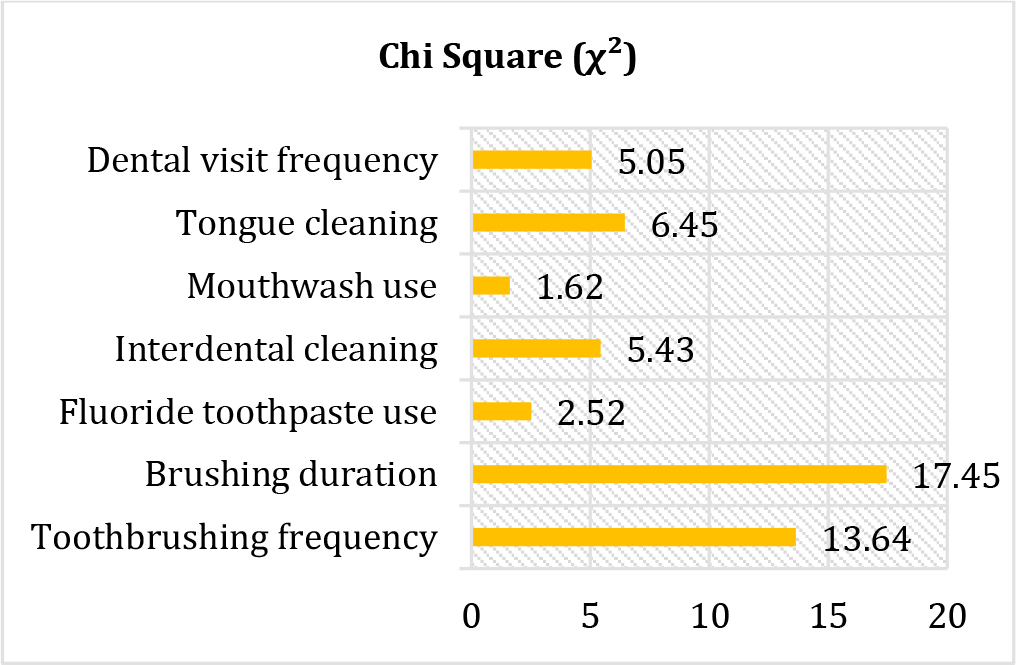
The chi-square test revealed statistically significant relationships between the gingival health status and the toothbrushing frequency (χ2 = 13.64, df = 3, p = 0.003) and tooth brushing duration (χ2 = 17.45, df = 3, p < 0.001). No statistically significant associations were observed for fluoride toothpaste use (χ2 = 2.52, df = 2, p = 0.284), interdental cleaning (χ2 = 5.43, df = 3, p = 0.143), mouthwash use (χ2 = 1.62, df = 3, p = 0.655), tongue cleaning (χ2 = 6.45, df = 3, p = 0.092), or dental visit frequency (χ2 = 5.05, df = 3, p = 0.168) Table 4. The oral hygiene practices assessed were also presented graphically as corresponding chi square statistics in figure 1.
| Variable | Category | n | % |
|---|---|---|---|
| Gingival bleeding | Never | 80 | 53.3 |
| Rarely | 50 | 33.3 | |
| Sometimes | 16 | 10.7 | |
| Frequently | 4 | 2.7 | |
| Swollen/red gums | Yes | 77 | 51.3 |
| No | 61 | 40.7 | |
| Not sure | 12 | 8.0 | |
| Routine dental visits | Every 6 months or more frequently | 30 | 20.0 |
| Once a year | 41 | 27.3 | |
| Only when having a dental problem | 68 | 45.3 | |
| Never | 11 | 7.3 | |
| Overall gum health | Excellent | 93 | 62.0 |
| Good | 43 | 28.7 | |
| Fair | 10 | 6.7 | |
| Poor | 4 | 2.7 |

| Variable | χ2 | df | p-value | Interpretation |
|---|---|---|---|---|
| Toothbrushing frequency | 13.64 | 3 | 0.003 | Significant |
| Brushing duration | 17.45 | 3 | <0.001 | Significant |
| Fluoride toothpaste use | 2.52 | 2 | 0.284 | Not significant |
| Interdental cleaning | 5.43 | 3 | 0.143 | Not significant |
| Mouthwash use | 1.62 | 3 | 0.655 | Not significant |
| Tongue cleaning | 6.45 | 3 | 0.092 | Not significant |
| Dental visit frequency | 5.05 | 3 | 0.168 | Not significant |
Brushing at least twice a day was independently associated with lower odds of poor gingival health (AOR = 0.17, 95% CI: 0.07–0.42, p < 0.001) in the binary logistic regression analysis. Likewise, brushing for less than two minutes was associated with poor gingival health (AOR 0.13, 95% CI 0.05–0.36, p < 0.001). Regular interdental cleaning (AOR = 0.48, 95% CI: 0.20–1.15, p = 0.101), mouthwash use (AOR = 1.52, 95% CI: 0.65–3.59, p = 0.336), tongue cleaning (AOR = 0.86, 95% CI: 0.35–2.07, p = 0.732), routine dental visits (AOR = 1.68, 95% CI: 0.71–3.93, p = 0.236), female sex (AOR = 1.35, 95% CI: 0.55–3.31, p = 0.511), and age ≥24 years (AOR = 1.23, 95% CI: 0.47–3.23, p = 0.669) were not statistically significant predictors of poor gingival health Table 5.
| Predictor | AOR | 95% CI | p-value |
|---|---|---|---|
| Brushing ≥2 times/day | 0.17 | 0.07–0.42 | <0.001 |
| Brushing ≥2 minutes | 0.13 | 0.05–0.36 | <0.001 |
| Regular interdental cleaning | 0.48 | 0.20–1.15 | 0.101 |
| Regular mouthwash use | 1.52 | 0.65–3.59 | 0.336 |
| Regular tongue cleaning | 0.86 | 0.35–2.07 | 0.732 |
| Routine dental visits | 1.68 | 0.71–3.93 | 0.236 |
| Female gender | 1.35 | 0.55–3.31 | 0.511 |
| Age ≥24 years | 1.23 | 0.47–3.23 | 0.669 |
The present study aimed to assess the relationship between the oral hygiene practices and self-reported gingival health among 150 dental University students of Pakistan. While there was many positive oral hygiene practices reported, gingival symptoms were still prevalent. 90 (60.0%) of the participants brushed their teeth twice a day, 117 (78.0%) used fluoride toothpaste and 77 (51.3%) had swollen or red gums. 20 (13.3%) participants reported having gingival bleeding, sometimes or frequently. These results indicate that dental education does not always result in people's consistently optimal personal oral hygiene practices.
The results can be compared with Al-Zarea et al. [17] who found that there was a significant number of gingival bleeding and flagged the significance of oral hygiene in ensuring periodontal health. In this present study, 13.3% of the respondents reported that their gums bleed sometimes or often. The younger percentage is due to differences in age, population characteristics, oral hygiene habits and assessment procedures. Importantly, it was an investigational study based on self-reported gingival symptoms and not gingival examination and did not allow direct comparisons with clinically measured outcomes.
The association between oral health behaviors and gingival bleeding was also pointed out by Pacauskiene et al., [18] in the case of students. The results of their research corroborate the need for proper oral care even among health-educated people. As for the other factors studied, frequency of toothbrushing was highly significant for gingival health with a χ2 value of 13.64 and p value of 0.003, whereas the brushing duration was even more highly significant with a χ2 value of 17.45 and a p value < 0.001. The results suggest that mechanical plaque removal may not only be effective in reducing frequency but also in increasing the duration of mechanical plaque removal to be associated with better gingival health.
Al-Wesabi et al. [19] pointed out the significance of the knowledge and preventive measures of oral health among health-care providers. The findings in the present study also indicate that there exists a potential disparity between professional knowledge and personal behavior. Even though 51.3% of the participants were dental students, they still reported having swollen gums or gums that were red. This emphasizes the need to teach effective preventive practices as well as theory when teaching dentistry.
The present results also support Gallione et al. [20] who stressed the need to incorporate oral health promotion into general health education and in professional practice. According to the results of our study, 23 (15.3%) of the participants used interdental cleaning every day, and 45 (30.0%) participants did not use any interdental cleaning methods at all. Likewise, 23 (15.3%) of the participants reported using mouthwash daily. It shows that information about preventive oral health care practices is not necessarily accompanied by consistent application of recommended practices.
Al-Qahtani et al. [21] also emphasized on the role of oral health knowledge, awareness and preventive behaviours. The present study, however, did not find any significant relationships between the use of fluoride toothpaste, interdental cleaning, mouthwash, tongue cleaning or regular visits to the dentist, and gingival health. 117 (78.0%) participants reported using fluoride toothpaste which was not a significant factor for gingival health (χ2 = 2.52, p = 0.284). Likewise, interdental cleaning, mouth washing habits and tongue cleaning did not have statistically significant associations with caries status, as did the number of dental visits Table 4.
The most significant result was that the frequency and duration of brushing were both independently related to the odds of less-than-ideal gingival health status. Participants who brushed at least twice daily had lower odds of poor gingival health (AOR = 0.17, 95% CI: 0.07–0.42, p < 0.001), while brushing for at least two minutes was similarly protective (AOR = 0.13, 95% CI: 0.05–0.36, p < 0.001) Table 5. These results indicate that mechanical plaque control is likely to be especially important for maintaining gingival health and that it needs to be performed consistently.
The lack of associations for interdental cleaning, mouthwash use, tongue cleaning and dental visits should be regarded with caution and does not mean they are not clinically relevant. These findings might have been affected by the difference in frequency and consistency of use, self-reported measurement and the lack of objective clinical periodontal assessment.
There are a number of limitations of this study. It is cross sectional; therefore, it is not possible to get to causality. These oral hygiene practices and gingival health were self-reported, and so may be subject to recall and social desirability bias. Convenience sampling and online recruitment can also hinder generalizability. In addition, the clinical periodontal measurements were not conducted, and the results are therefore only applicable to self-reported gingival health and not to the clinically diagnosed periodontal disease.
The overall results showed that while the majority of the dental students had good knowledge about oral hygiene, the symptoms of gingivitis were still present. The independent factors that were related to better gingival health were brushing at least twice daily and brushing for at least two minutes. Implementing positive oral hygiene habits in undergraduate dental education can contribute to the development of sustainable oral hygiene habits. Multicenter longitudinal studies using objective periodontal assessments in the future are recommended to validate the results obtained.
The findings indicate that the mechanical effectiveness of toothbrushing in terms of its frequency and duration, may be the key to the protection of gingival health within this population. This study indicates that the emphasis should be placed on the twice-daily act of brushing for at least two minutes as a key element of an undergraduate dental curriculum. Additional longitudinal studies with clinical periodontal evaluations are recommended to validate these relationships and to evaluate the long-term effects of behavioral interventions on gingival health outcomes in dental students.